
Writing Planetfall 2: Children of Fall

At long last I have finished and published Children of Fall, the second book in the Planetfall trilogy. Phew, and Yay!planetfall 2 title graphic

In this blog, I’m going to take you behind the scenes of the novel. I’ll show you some of the process in building the story, writing the first draft, how early (constructive) criticism changed the novel between the first and final draft, and then explore the journey to creating the cover art.

First, if you haven’t seen the book online and want to buy it, then paperback and Kindle options are on the links below:

Buy paperback or Kindle (Amazon)

Buy paperback (not Amazon)

Conceiving the story

Children of Fall has taken ten years to write, and is the biggest and most complex book I’ve ever written. I first conceived the story in 2007, and realised by 2008 that I didn’t have the skill as a writer to bring to life the story in my head. It probably took me about 65,000 words of writing, scrapping material and re-writing to come to this conclusion. There also seemed to be a lot of back story to get the reader to a point of understanding the story I wanted to tell, which forced me to a logical conclusion: I needed to write another novel first, something simpler and more straightforward, to set the scene. This became Planetfall book 1: All Fall Down.

The starting point of Children of Fall (and the whole Planetfall series) was inspired by Quatermass and the Pit, an old science fiction film in which an astronaut returns to Earth, infected with alien DNA. I didn’t so much want to re-tell that story, as use it as a point to jump from: what if a soldier on the front line of a war became infected with alien DNA? How would that soldier be treated? What might that soldier become?

Thoughts about DNA suggested a structure for the novel: there would be two stories, intertwined, like the double-helix of DNA. At points they would come close and at others they would spiral apart. This meant writing two separate stories, side by side, which occupied the same universe and the same overall narrative, but which had their own characters and viewpoints.

After writing All Fall Down, a process which took 3 years, I tried to write Children of Fall again, and failed again. I was committed to the story structure – I could see it in my head – but I couldn’t make it happen on the page.

The next book I wrote was Backpackers, a romantic fiction novel about young people backpacking through south east Asia. The structure of that novel is of a series of short stories, each based on a different character, but who all come into contact with the book’s protagonist, Cath Pearson. Each story comments in some way on that central character, so we see slices of her drama. This let me build my skills in writing from different characters’ points of view, letting a longer narrative play in and out of other stories, and getting it all to make sense. I was building my writing muscles: first, I had written a novel from start to finish in the universe I wanted, and then I had written a novel with a similar structure to the one I wanted to write.

After those two novels were finished, I made my next attempt, and managed to write a decent amount of a first draft. But the story at that point was different to what it is now. I started with the former inhabitants of Fall being refugees, aboard their own starship, and committing piracy to stay alive. They wanted revenge on their former colony administrator, and kidnapped Kate Leland in the hope she would be their leader. Kate also started out at a different point in her life: an embattled war General, who steals an old ship to house the refugees and let them hide beyond military sensors. The other main character, Swan, had something closer to a hero’s journey. He even tracked down Daoud at one point, and tried to kill him. You won’t see anything of this in the new novel, and once you’ve read it, you’ll wonder how the finished story could even have included the above.

Receiving criticism and re-plotting

With that first draft in hand, I put the draft novel to one side, intending to come back to it a month later. Events overtook me: the UK’s former Prime Minister Baroness Thatcher died, and a story idea came to me. I have written about that on this blog, suffice to say the month became somewhat longer, until another couple of years had gone by. I released that new book, Sympathy for the Devil in 2015, and returned to Children of Fall.

I tidied up the draft and sent it to a trusted beta reader. His feedback contained the catalyst for scrapping most of the first draft (again!) and re-writing almost from scratch. Amongst two pages of feedback on individual chapters, lines, typos and overall story commentary, he wrote this:

“I didn’t get much of a sense of Kate this time around. I remember last time thinking she was fully formed and focussed as a character. This time she seems less focussed, except maybe at the start, when she steals the ship and goes to fall. I didn’t really get the grand plan she had to stop the war.”

When I started to unpick Kate, and try to understand why this might be, the entire plot fell apart. This comment proved to be the single thread that causes a carefully knitted garment to unravel. Out went the ship stealing (too aggressive), out went the grand plan (too vague, obviously, but too organised as well – it took away the dramatic tension). Importantly, I took that comment on her having “less focus” [sic] and used it, completely re-imagining where Kate might be a dozen years after the first book. Kate is less focused from the start of the book now, but she is deliberately out of focus: even she doesn’t know who she is. Indeed our first view of her is as a hologram, unreal, made of light, gone at the flick of a switch. As the book goes on, and events unfold, a new Kate emerges and comes into focus. But even at the end, we don’t fully understand who she is. And neither does Kate. She’s someone who has lost touch with herself, who is running away, and who needs to make a decision: does she keep running, or does she commit to something bigger?

I want to make the point, which I think is fairly clear, that early drafts of books need criticism, they need objective viewpoints to force us to think differently about our stories. No story, no novel, can be any good without feedback and criticism at different stages.

Developing the plot

Having an idea about a soldier who becomes infected with alien DNA is all well and good, but how do we find the story around it?

All Fall Down gave me the space to find the alien DNA: it was in place at the start of Children of Fall. The moment of infection I also had early on – without going into spoiler territory, I very much wanted a scene like one you would find in a superhero comic. But it also had to feel real and believable.

I was helped in this by some feedback on an early chapter I took to my writing group. In the early draft, Swan invades a ship and comes face to face with the alien enemy. The aliens are described, and a battle ensues. At my writing group, I was given a throwaway suggestion: don’t ever let us see the aliens, so that they have more power. This led down two paths. The main alien enemies in the book are never seen. They’re referred to, and the most description we get is that one species is “lemur-like”. Beyond that, they’re ever-present, never seen, yet a constant threat.

At the other end of the scale, I thought it would be good to bring back the aliens from All Fall Down. Ones so large, so gargantuan, that their sheer scale would induce numbness in the reader. Not horror, not awe, but something too big to be human, humanised or understandable. A numb, blank spot in the story, around which Swan spirals. The opening lines of the book are deliberately meant to reference this effect, where Swan talks about memory wipes, of feeling like his head is full of snow and ice, of feeling blank. It foreshadows what is to come, and also links us back to Kate in All Fall Down, when she wipes a key character’s memory.

Dehumanisation is a key theme of the book. We find many of the characters losing their humanity and their empathy as the book progresses. Children are grown to become soldiers; not only is every character flawed, but many of them are actively trying to avoid humans or otherwise send them to their deaths. Marines are clad in organic battle suits, looking “monstrous”, like something that has “crawled out of a swamp”.

Cover art

I start the cover art process by throwing a lot of visual ideas at my cover artist. These will be images that I might have used as inspiration for certain scenes or characters, or that helped me with mood or feel or emotion.

Below you can see some art work that covers space scenes, classic scifi UFO-type art work, some panels from Swamp Thing, and two book covers.
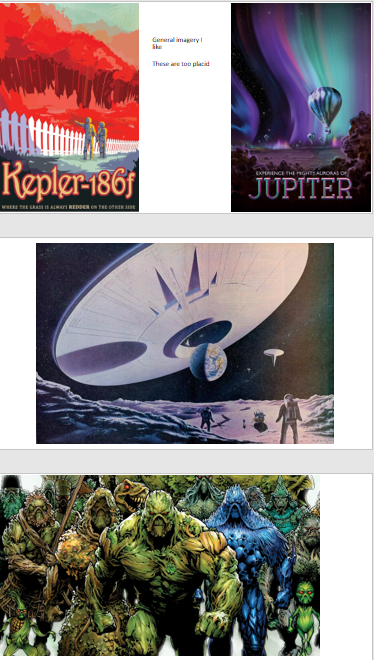
cover dev 1cover dev 2

Accompanying these visual ideas is a summary of the story, key themes in the book, character profiles and any particular scenes that help to bring the story or character to life.

Rob, who produces the Planetfall covers, then works on an outline cover idea. This [below] was an early draft. At this point I give constructive feedback, which again takes the form of both written comments and visual ideas.

Original Children of Fall cover idea

Children of Fall draft cover idea

Below are images I sent back along with my feedback on the cover art. The overall comment was that the cover needed more drama and more contrast.
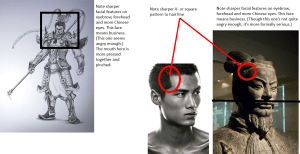
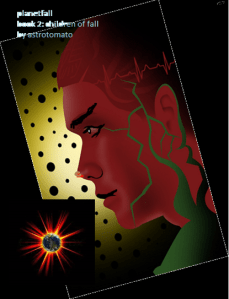
In the images above you can see some specific images connected with hairline (top-left). There are also images connected with the texture of the mutation creeping up Swan’s face (top-right and bottom-left: ‘Mutation’ by Tom Stewart).

The top-middle image shows the draft cover angled over, with an exploding asteroid or sun in the bottom left-corner, a suggestion towards the need for more drama.

Out of all this comes the final cover image:
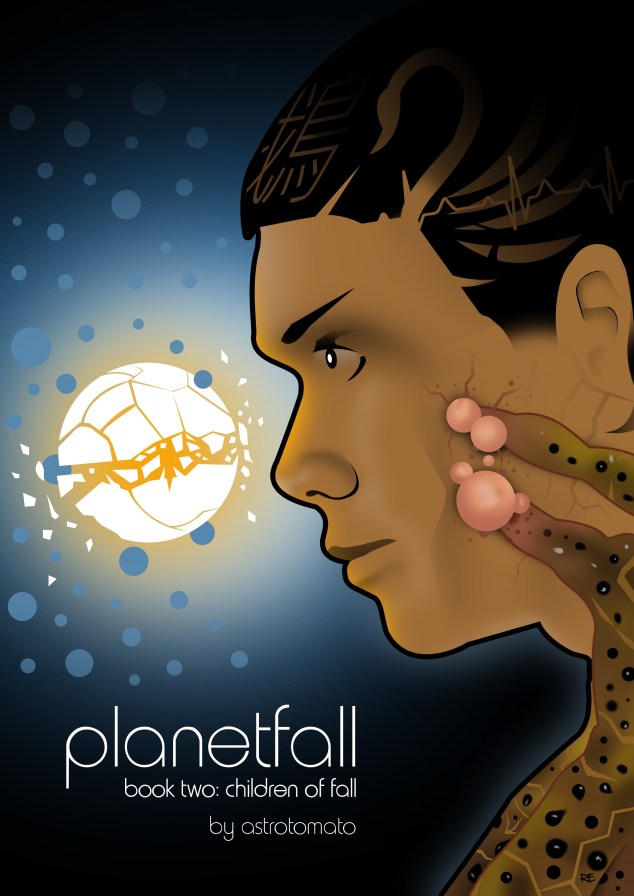
planetfall 2

Sympathy for the Devil – deleted material

I’ve had no luck finding representation for Sympathy for the Devil, so am moving ahead with self-publishing. Some very kind people are checking the text for typos, and I am working with a comic artist to produce the front cover.

In advance of its publication (possibly in August), here’s some deleted material.

The following passages bear no relation to the final story, except in that they eventually acted as background notes for a character in the book (who has a slightly different name). The text here centres on events in the north east of England in the 1980s, during the miners’ strikes.

Note: the text is unedited, and features typos and some awkward grammar.

Sympathy for the Devil – deleted material

Part I

It started in Yorkshire, when Little Ruthie put up her hand and said, “My dad says there’s no such thing as G-d. He says there’s no need for G-d in nineteen eighty four.”

Mr. Sowerby, her teacher, held his hand behind his back. Between thumb and forefinger he squeezed the stick of compressed skeletons with which he wrote confused facts about people long since dead. “Does he now? I know your dad. Taught him in this very classroom, Miss Willoughby.”

“Yes, Sir.”

“He,”

“But he does say that Margaret Thatcher is the devil.”

“Really?” Squeeze. “And who is the Saviour, then?” A smile full of pride on his face.

“Mr. Scargill, dad says.”

“That donkey jacketed,” squeeze, but she interrupted again.

“Sir, my dad says Manvers will never be closed. That’s why Mr. Scargill’s got them to walk out. To keep it open.”

“So he’s a picket, is he? Always was a trouble maker. You listen to me. Your dad could have had a proper job, rather than being buried underground ten hours a day hitting rocks. Thatcher’s Britain doesn’t need uneducated oafs. It needs people with O levels and ambition. Britain needs strivers, not miners.”

There, that shut her up. Ten years old and full of herself.

“Sir?”

“Miss. Willoughby.”

“My dad says Mrs. Thatcher is a complete,”

“We’ve all heard quite enough from you, Miss Willoughby. Let’s return to your religious,”

“When I’m Prime Minister I’ll re-open Manvers.”

Little Ruthie ducked as the chalk flew over her head and shattered on the wall behind her. It made a high pitched chink when it struck the tiled floor, where it rolled from side to side to side to side. Children looked every which way.

“There’ll be no presumption in this class, you hear me? This is a religious education lesson. I am in control.”

O’d faces all around the class. No one had ever seen Sowerby mad.

Little Ruthie looked at him and opened her mouth to speak.

“Enough!” he shouted.

“I’m telling my dad on you.”

“Tell him all you like. If you can get him off the picket line. These strikers care more about coal than they do their families. Now, anyone else wish to discuss the politics of Communists? No? Good. Then please open your bibles to the Book of Job.”

Little Ruthie flicked through the pages. Her eyes were out the window, on the distant colliery where the wheel no longer turned. No fun fairs here in Wath, not any more. The only spinning lights cane from the riot vans at the coal plant.

One day, she thought, one day I’ll prove my dad’s right.

Part II

Little Ruthie, Ruth Willoughby, ten year old Yorkshire lass. Hair pulled back under an Alice-band. School bag already decorated with pins for Bananarama and Adam and the Ants.

The streets of Wath-upon-Dearne were decorated with banners, “SUPPORT THE MINERS”.

Policemen walked around in pairs or sat in riot vans, bored, waiting for something to happen. Pissy little mining towns with their upstart miners. Why couldn’t they just get other jobs?

Men in donkey jackets stood at braziers, watching pathetic flames lick at the cold air. The great chimney at the colliery was quiet, its usual belch settled in its belly. They grumbled about the lack of jobs, and talked about the families who had moved south, to the factories of the Midlands. One family had even moved to the south coast to open a bed and breakfast. Not one of the men could bring themselves to call those who’d gone traitors. But still the word floated in the air between them, missing its lightning rod.

“It’s John’s girl,” one of the men nodded his head at Little Ruthie. “John! Your lass is here.”

John Willoughby was stood in a group of miners, a confabulation.

“Ruthie, come ‘ere love,” suddenly all smiles for his daughter.

Over their shoulders, the coal ramps were still. The site was asleep, the workers outside and above ground, the coal slumbering in its bed.

“Bring her along, John. She should see,” said one of the other men.

“You want to come to Orgreaves, Ruthie? We’re going on a demo up Rotherham way.”

“OK.”

“It might be a bit scary. Lots of pigs around.”

Little Ruthie held her dad’s hand. The callouses and ground-in coal dust were home, her tiny hand was soft and clean, now smudged with that solid fuel that burns so well. She could smell her dad a mile away, the pit was in his lungs and his bones.

“Will Margaret Thatcher be there?”

“Trained her well, John!” shouted the men behind him. They laughed and turned away.

“No, she won’t come up here. Them politicians don’t care, Ruthie. We have to care instead. Listen, don’t tell your mam we’re away to Orgreaves, you know how she is.”

“I’ll say I’m at Nanny and Granda’s, don’t worry.”

“There’s my girl.”

A coach pulled up. Men moved and shared cigarettes, small roll-ups which drooped and went flat between their fingers.

Little Ruthie climbed onto the bus, the only girl amongst those grown-up men, strikers, pit workers.

Little Ruthie went on the bus to Orgreaves, her first demonstration.

Ten year old Little Ruthie darted between the legs of policemen and strikers alike, avoiding the truncheons and flung stones.

Little Ruthie hid behind a police car, hating its protection, and watched her dad struck, fall to the floor, blood on the tarmac and between its cracks where grass pushed up, ever hopeful.

Ten year old Little Ruthie hated Margaret Thatcher.

Little Ruthie, Ruth Willoughby, cradled her dad, John Willoughby, while he held his cut head and looked at his blood on the soil of his country. “Never forget, Ruthie,” he said, all the way to the hospital, and all the way home. “Never forget.”

London writing group seeks new members

Hi,

My writing group is looking for new members to join. Are you interested?

We are a serious writing group, and between us we have finished at least 2 novels each, self published works, have had plays produced or come 2nd place in national novel competitions.

We are looking for new members who:

  • can meet monthly for most months of the year (we meet on at least 10 out of 12 months)
  • are willing to share their own material for critique
  • will give some time to critique shared material from other members
  • are willing to learn and develop as writers, and
  • may be willing to host a meeting once every few months (we circulate between members).

Who are we?

My author profile is on Amazon here: http://www.amazon.co.uk/-/e/B00AX49ZUE I am principally a novelist, and am currently working on a political comedy. I have a few short film or TV pilot scripts under my belt, as well as a collection of short stories, and am an alumnus of City University.

Tara Basi is a Birkbeck writers alumnus and a novelist and playwright. He writes dystopian fiction and satirical plays/radio plays. He is self-publishing his first novel this year.

Max Novaz is also an alumnus of Birkbeck, and is principally a playwright of farces, with his first production recently performed in Bedford. Max is currently working on a novel, and editing a play set in a Spanish holiday resort.

We are open to fellow writers of all levels of experience. A fondness for Rioja would be advantageous!

If you are interested, we are happy to meet somewhere public, on a trial basis, and to share material with you in advance so you can gauge the quality of our work and personalities. We generally meet on the last Friday of the month, but we are open to this. (Fridays allow for a drink after the writing talk.)

Please contact me, Graeme, on astrotomato@gmail.com or via DM on Twitter @astrotomato

All the best,

Graeme x

A sneak peek at “Sympathy for the Devil”

Since April I’ve been writing a novel which I’ve heretofore called a “secret project”, simply because I had no title for it.

Around early August I hit upon a title: Sympathy for the Devil. And at the same time I finished the first draft of the novel. It was a quick turnaround for a first draft: about 4 months, writing in my spare time outside work.

During August I rested the material and started writing some new material for Sympathy, with the intention of matching it up when I started editing. I find this an important exercise when writing – it gives me an opportunity to ‘brain dump’ material that never quite made it into the first rush through the narrative, or which might give clues for editing or character or plot development.

Longer-time readers will know that I occasionally publish rejected material for my books, and I’m repeating that habit here. Pasted in below is a rejected Chapter One for Sympathy. There’s nothing wrong per se with the writing, except for one thing: the tone and voice of the material, and the narrative perspective, doesn’t fit the rest of the book. This rejected Chapter One is written from a 3rd person omniscient point of view, whereas the rest is from a 1st person. And this text includes a confused amount of the unique voice of the main character. On which note, a warning: the main character’s voice is in poor grammar, so you’ll see wrong words in places. These are deliberate, not typos. Spelling mistakes are typos, but poor grammar isn’t.

I owe a debt of thanks to my writing circle for convincing me to reject this material.

If you’re still reading by this point, and want a sneak peek at Sympathy for the Devil, then here you go. This is the real background to the novel, but the material won’t make it into the final edit.

Enjoy,

astro x

Sympathy for the Devil:

[REJECTED & UNEDITED]

Chapter One – 1984 CE, 1945 CE, 61 CE

It started in many places. Three, if you want to focus. But who’s to say they was more important than another three? Let me pick one for you, though, my love. Because you’re new to this and you want to know what’s going on, ain’t I right?

Now how do I know where it started, you’re wondering? Me and all. Well, there’s some things what you just know. Know what I mean?

It started up north in Yorkshire in 1984CE, when Little Ruthie put up her hand and said, “My dad says there’s no such thing as G-d. He says there’s no need for G-d in nineteen eighty four.”

Mr. Sowerby, who was her teacher, held his hand behind his back. Between thumb and forefinger he squeezed the stick of compressed skeletons what he wrote confused facts with about people long since dead. “Does he now? I know your dad. Taught him in this very classroom, Miss Willoughby.”

“Yes, Sir.”

“He,”

“But he does say that Margaret Thatcher is the devil.”

“Really?” Squeeze. “And who is the Saviour, then?” A smile full of pride on his face.

“Mr. Scargill, dad says.”

“That donkey jacketed,” squeeze, but she interrupted again.

“Sir, my dad says Manvers will never be closed. That’s why Mr. Scargill’s got them to walk out. To keep it open.”

“So he’s a picket, is he? Always was a trouble maker. You listen to me. Your dad could have had a proper job, rather than being buried underground ten hours a day hitting rocks. Thatcher’s Britain doesn’t need uneducated oafs. It needs people with O levels and ambition. Britain needs strivers, not miners.”

You can imagine him thinking, There, that shut her up. Ten years old and full of herself.

“Sir?”

“Miss. Willoughby.”

“My dad says Mrs. Thatcher is a complete,”

“We’ve all heard quite enough from you, Miss Willoughby. Let’s return to your religious,”

“When I’m Prime Minister I’ll re-open Manvers.”

Little Ruthie ducked as the chalk flew over her head and shattered on the wall behind her. It made a high pitched chink when it struck the tiled floor, where it rolled from side to side to side to side. Children looked every which way.

“There’ll be no presumption in this class, you hear me? This is a religious education lesson. I am in control.”

O’d faces all around the class. No one had ever seen Sowerby mad.

Little Ruthie looked at him and opened her mouth to speak.

“Enough!” he shouted.

“I’m telling my dad on you.”

“Tell him all you like. If you can get him off the picket line. These strikers care more about coal than they do their families. Now, anyone else wish to discuss the politics of Communists? No? Good. Then please open your bibles to the Book of Job.”

Little Ruthie flicked through the pages. Her eyes was out the window, on the distant colliery where the wheel no longer turned. No fun fairs went to Wath, not any more. The only spinning lights came from the riot vans at the coal plant.

One day, she thought, one day I’ll prove my dad’s right.

And it started in London in 1945CE, where it carried on decades later. And sometimes for startings, names ain’t so important, not now and not after.

“Let’s see,” said the girl. “Is it really Mr. Churchill?”

“He’s with someone. Who is it?”

“Shh, shh, he’s gonna speak.” The girl craned her neck.

“He’s done us ever so proud,” said someone nearby.

“It’s his victory what’s freed us,” said a woman close to the girl.

“We should all say that, eh?” said the girl. “Shout at him, ‘It’s your victory!’”

“’It’s your victory.’ I like that. Here, mate, you hear what she said?”

And so on through the crowd.

Winston Churchill took the balcony of the Ministry of Health, abet by two colleagues. The skies were finally clear. That nice Mr. Hitler’s bombs and doodlebugs and V2 rockets were silent, his scientists fled to America to dream of space and rocket ships.

“Here he goes, shh shh,” said the girl.

On different sides of the throng of people, two men dressed almost identically started pushing their way in. They thought very similar thoughts and were headed for the same point in the crowd. Each was in a smart wool suit, fedora, Mackintosh coat. Even in the crowds they cut a dash, while their eyes and elbows cut a swathe. One was tall, the other short. From a distance that was the only difference.

“G-d bless you all. This is your victory!” said Winston Churchill from the balcony.

“No, it is yours!” shouted the crowd. People looked around at each other. They’d done it, said the thing all together. There was that spirit, still working together, singing the same message. They all cheered. It was a new dawn, a new day. Britain was a community, working together to defeat National Socialism. Now Britain was victorious, triumphant.

Churchill looked down at the crowds of people: nurses, labourers, soldiers, children.

“It is the victory of the cause of freedom in every land,” he continued. “In all our long history we have never seen a greater day than this.”

In the crowd, the two men pushed, separately, through hugging friends and wormed through strangers bonded over that singular moment of triumph.

“Everyone, man or woman, has done their best. Everyone has tried. Neither the long years, nor the dangers, nor the fierce attacks of the enemy, have in any way weakened the unbending resolve of the British nation. G-d bless you all.”

Applause. Cheers. Hats thrown in the air in that way what don’t happen no more. London in celebration, a nation glued to its valve-radios and memories of steamer ships and Victorian colonies. Flags flipped back and forth, hearts swelled with pride, relief and grief and loss.

In the crowd there was a surge, and it pushed a gentleman against the girl.

Further back, another gentleman looked on, eyes flat. He tipped his hat and turned: it was too late. He would have to wait. He disappeared into the crowd, melted away into London and the world and future plans.

She, the girl, looked round, briefly, at the contact. People pushing didn’t bother her. It was a crowd. Besides, she thought, it was gentle and felt nice. Sort of cosy, like. And she knew the cues, the signals, how her profession worked.

Churchill carried on talking, but the girl had places to go. There was money to earn, bread to put on a table. She turned and looked up into a smile and a twinkle.

“Quite the speaker, isn’t he?” said the man behind her. Nice hat, she thought. Nice suit.

“Did you hear what he said?” she smiled back. “We all done our best. No one ever said that before. Least not to me.”

The man looked into her eyes, “I wonder if a victory gin would be appropriate?”

“For you or for me?”

“For us both.”

“Sauce. Don’t even know you.”

“Perhaps,” and he leaned until his breath stroked the fine hair on her earlobe, “today demands the spirit of triumph, rather than the spirit of propriety.”

She looked at him, her hands fiddling with a purse, irises never quite settling in one place. “Where was you stationed?” she asked. “Gotta know you’re respectable, ain’t I?”

“North Africa, originally,” he said, and pulled back, adjusting his hat.

“Rommel and Montgomery?” she weren’t quite sure who they were. Surviving the Blitz and keeping up with what was happening over in France had taken all her time. But everyone knew the names, and it had always been enough to strike up a conversation with other clients.

“Something like that,” the man smiled. “What’s your name?”

She tugged his tie, gently, gently smiling, “No names today, Mr. Desert Fox. Gin and triumph only. Alright?”

He offered his arm, and they fought their way out of a cheering crowd.

They drank in a little place he knew, and then went to a quiet back street hotel where they saw in the dawn.

By the morning he was gone. Despite her insistence that the night was a celebration, there was still a pile of money on the dresser. “Bloody men,” she whispered.

A knock on the door, “You’ve had your fun. Ten minutes, then I call the police. Back to normal, missy. This is a respectable place.”

The girl pulled her clothes on and picked up the money. “Bloody Nora,” and she looked to the window, even though she knew he wouldn’t be outside, standing by a lamp-post, looking up at the window, waiting for a reaction. “Gin and triumph,” she whispered. She left behind the stained and crumpled bed sheets, and entered that new world with a swing in her step and a seed in her belly.

And it started somewhere above Watford, in Northamptonshire, long before it were called that in 64CE. It were somewhere along the Fosse Way, after the sacking of Londinium and Camulodonum and Verulamium. Bodies of Romans strew the land. And the warriors of the Iceni and Trinovantes and the other tribes lay with them, their blood seeping into the mystical land of northern Europe, that land what the Greeks called Albion. Cos sometimes stories don’t start all together. Sometimes you gotta go way back to the roots, ain’t ya?

“We are defeated.”

“My Queen, the Romans are too many and too strong. It’s impossible. Their ships arrive every day with more soldiers.”

“Send word Corslan. Despatch a rider to the Fair Folk. Then tell the tribal chieftans. Those who want to remain may do so. But we will take our armies and those who will come with us, and retreat.”

“My lady?”

“We retreat to Tír inna n-Óc until the time is right.”

“Retreat? But the Romans will spread and take Britain.”

“We will abide. The Fair Folk will provide a champion. When the time is right we will win back Ierne and Albion from the foreign invaders.”

“Yes, my lady.”

“Albion will endure.”

Little Ruthie, Ruth Willoughby, ten year old Yorkshire lass. Hair pulled back under an Alice-band. School bag decorated with pins for Bananarama and Adam and the Ants.

The streets of Wath-upon-Dearne was decorated with banners, “SUPPORT THE MINERS”.

Policemen walked around in pairs or sat in riot vans, bored, waiting for something to happen. Pissy little mining towns with their upstart miners. Why couldn’t they just get other jobs?

Men in donkey jackets stood at braziers, watching pathetic flames lick at the cold air. The great chimney at the colliery was quiet, its usual belch settled in its belly. The men grumbled about the lack of jobs, and talked about the families what had moved south, to the factories of the Midlands. One family had even moved to the south coast to open a bed and breakfast. Not one of the men could bring themselves to call those who’d gone traitors. But still the word floated in the air between them, missing its lightning rod. Traitors. Traitors. Traitors.

“It’s John’s girl,” one of the men nodded his head at Little Ruthie. “John! Your lass is here.”

John Willoughby was stood in a group of miners, a confabulation.

“Ruthie, come ‘ere love,” suddenly all smiles for his daughter.

Over their shoulders, the coal ramps were still. The site was asleep, the workers was outside and above ground, and the coal slumbered in its bed.

“Bring her along, John. She should see,” said one of the other men.

“You want to come to Orgreaves, Ruthie? We’re going on a demo up Rotherham way.”

“OK.”

“It might be a bit scary. Lots of pigs around.”

Little Ruthie held her dad’s hand. The callouses and ground-in coal dust were home, her tiny hand was soft and clean, now smudged with that solid fuel that burns so well. She could smell her dad a mile away, the pit was in his lungs and his bones.

“Will Margaret Thatcher be there?”

“Trained her well, John!” shouted the men behind him. They laughed and turned away.

“No, she won’t come up here. Them politicians don’t care, Ruthie. We have to care instead. Listen, don’t tell your mam we’re away to Orgreaves, you know how she is.”

“I’ll say I’m at Nanny and Granda’s, don’t worry.”

“There’s my girl.”

A coach pulled up. Men moved and shared cigarettes, small roll-ups which drooped and went flat between their fingers.

Little Ruthie climbed onto the bus, the only girl amongst those grown-up men, strikers, pit workers.

Little Ruthie went on the bus to Orgreaves, her first demonstration.

Ten year old Little Ruthie darted between the legs of policemen and strikers alike, avoiding the truncheons and flung stones.

Little Ruthie hid behind a police car, hating its protection, and watched her dad struck, fall to the floor, blood on the tarmac and flow between its cracks where grass pushed up, ever hopeful.

Ten year old Little Ruthie hated Margaret Thatcher.

Little Ruthie, Ruth Willoughby, cradled her dad, John Willoughby, while he held his cut head and looked at his blood on the soil of his country. “Never forget, Ruthie,” he said, all the way to the hospital, and all the way home. “Never forget.”

The girl quit her old job. Not that there was a boss to tell. She just stopped turning up at the regular places.

The man had left her more money than she earned in three years. Five. She bought a house, decorated, bought plants. Started a small allotment. Dig for victory! still rang in her mind.

She took up sewing work.

Well, she had to. She knew almost immediately that the gin and triumph of victory in Europe had become motherhood and hope. The other girls told her about back street doctors, about women who had gin and coat hangers and hot baths and towels.

“No. It’s a new start,” she told them.

And forty weeks later, she gave birth in that small house, and as the midwife was tidying her room, the man walked in and sat down. Bold as brass. Nary a word nor letter in between before and then.

“Mr. Desert Fox,” she said, hair slick to her forehead. The baby was clamped to her nipple, gumming it, blind, a maggot squirming in swaddling. “Had a feeling you’d be back.”

“Wild horses and all that. So, boy or girl?” He took a seat from the opposite side of the room and put it next to the bed. No other introduction or by your leave. No explanation. Straight in, treated the place like it was his. Which.

“Girl,” said the girl. Woman now. Mother.

“She’s perfect,” said the midwife. “Don’t mind me, I’ll be on my way. I’ll pop in tomorrow, see how you are. Good day,” a professional nod to the man. She saw similar things every day. A baby boom, she called it. The Victory Effect, others said.

“You left me alone at that hotel,” said the woman, mother. She stared at her daughter’s face, the gummy eyes.

“Duty called.”

“It’s OK. Thank you for,” she looked at the walls of the house and around. “What shall we call her?”

Straight away, “Lucy. The light bearer. The morning star.”

“Morning star, I like that. Here, Lucy, meet your father.”

The man held his daughter and looked into her face, “Lucy. You’re going to run this country one day.”

“You can hold her a bit longer,” said the woman, “I need my sleep. Do you mind?”

“Of course not.” The man walked away with the baby and left the mother to sleep.

When the midwife returned the following day, she found the woman still in bed, propped up on pillows. Her face was serene. Possibly the most beautiful face the midwife had ever seen. Not for her natural beauty; she was plain at best. But for the look of deep contentment and peace which had settled over her.

Shame, thought the midwife. The bed sheets was already turning black, the blood dried to a resin.

“Haemorrhage,” the midwife shook her head. “Where’s little miss? She’ll need a wet nurse.”

But the baby weren’t anywhere to be seen.

“My lady. We have what villagers will come. Some of our warriors have chosen to stay.”

“Very well. And the Romans?”

“Sending heralds to the other tribes. They will soon know of our defeat.”

“Queen Boudicca is never defeated.”

“No, my lady.”

Queen Boudicca looked over a stone fence at the rolling green of Albion. “I have a final mission for you. This is your life’s work.”

“My lady?”

“My son. I’m appointing you as his protector, Corslan.”

“I’m honoured. But,”

“I am not going with you. I am the last of the Iceni. Britain goes under Roman rule. But promise me one thing, Corslan, Steward of Britain.”

He said nothing, instead standing straighter and looking to the horizon.

“These islands, Albion and Ierne, will soon be over-run with Romans and their gods. The Fair Folk have agreed to grant you the power of Tír inna n-Óc. We will absorb the Romans, they will become British, and we will win the slow victory. But others will come behind them. New people, new gods. Defend our lands, Corslan, defend Britain against the darkness, against chaos, against anyone who does not hold our values.”

“Yes, my Queen.”

“And when the time is right, put my son on the throne of this land.”

“And what about you?”

She reached out, a muddy hand in a misty field on a young captain’s shoulder. He became a Queen’s knight, “I will become myth. Legend. We shall not meet again. But my spirit will be in this land evermore.”

Corslan kept his gaze on the horizon, “The morning star is risen.”

“Sunrise approaches. Take our people. Protect my son.”

“He shall take the throne, Queen Boudicca. For Albion.”

“For Albion.”

[end]

Editing Sympathy for the Devil

Writing update 26/08/2013

I finished a first draft of Sympathy for the Devil, my new novel. The novel started well, but I wrote it without a thought on overall plot, which meant it went awry near the end.

The first edit I’m doing is for grammar, fill in sentences and tidying up the dialect it was written in. I find it hard to edit when there are simple readability errors in the text.

The next edit will be for storyline. There are 2 significant sub-plots which need considerable strengthening or re-writing.

Overall, though, I’m please with the first draft, and looking forward to a stronger novel coming into shape throughout September and October.

I may post some sections of it as editing goes on – maybe of deleted material to give a taste of the novel’s tone.

Hope you are all enjoying your own writing,

astro x

5 Reasons Why New Authors Should Use Clichés

I started writing fiction when I was about fifteen years old. It was 1988, Margaret Thatcher appeared an unstoppable force in the UK, and The Smiths were a popular band. It was misery in politics and misery in the charts. And writing, for me, was an escape.

That’s the clichéd start to how many of these blogs start, isn’t it? “I wrote as an escape.”  And for those people who say that they wrote – write – to escape, it remains true. It’s a truth repeated so often that it has become a cliché, albeit one we allow to continue existing, because we don’t want to take anything away from people’s feelings.

Fine.

But if you read writing blogs that aim to help new authors, you’d be forgiven for thinking that clichés are verboten, that they’re forbidden in all creative writing endeavour. And I think this is wrong. If we’re allowed to start writing for the same reason – it was an escape – then why can’t we write clichéd things?

Below, I argue that we can, and indeed should, write in clichés. This argument is very much aimed at people new to fiction writing, to help cut through the confusing ‘rules’ on other blogs.

Reason #1 – The 7 Basic Storylines

There are seven basic plots that underpin all stories, or so argues Christopher Booker in his seminal work The Seven Basic Plots. (You should buy this book.)

These plots are:

  1. Overcoming the Monster;
  2. Rags to Riches;
  3. the Quest;
  4. Voyage and Return;
  5. Comedy;
  6. Tragedy;
  7. Rebirth

Often these plots are combined, such that we might have a Voyage and Return, like Jason & the Argonauts, in which the hero must also Overcome the Monster.

I won’t describe the basic plot types, but the point here is simple: if we can boil all plots down into one of these basic seven types, with a dash of another thrown in depending on the cocktail presented to the reader, then we are quickly bound to clichés anyway.

“A-ha!” you argue, “but if there are only seven basic plots, then shouldn’t we do our best to escape cliché elsewhere?”

Not yet, dear new author. Not yet. Otherwise there’d be no blog for me to write! But let us ignore that inconvenient truth, and explore reason to cliché #2.

Reason #2 – Wriggle, Wiggle, Crawl, Walk, Run, and Fly

Imagine this: you’re a new mother or a new father. There’s your baby just days old. Her or his little fingers wiggle in your hand, their chubby knees squirm at your tickle and their delicate feet are too cute for words. Now, carefully put the baby on the floor in your home, stand back, and say:

“Baby of mine, I want you to stand up right now, walk to the door, run to the nearest airport, buy a plane ticket, hop on the plane and go travelling!”

What do you mean it’s just a baby and it’s impossible? Tell it to fly immediately, damn it!

You get the point. New authors are like new babies. You’re perfect in every one of your toes and fingers, and each of your letters and words on the page is lovely and cute. But like that baby, you need to practice the basics first.

We don’t look at a baby and say, “Oh god, it’s so clichéd, crawling. Come on, little bubba, innovate a different way to strengthen your legs.”

No, we encourage them to wriggle and wiggle. We help them stand until they can stand on their own. We help them to walk by holding their hands, until they can manage their first few steps unaided.

And that’s how it should be when we’re learning to write. Practice the basics first. And that means practicing the clichés. For example:

Develop a simple love story.

Write a story about going into a cave and fighting a monster.

Craft a tale of a hero who is too flawed, and becomes a victim of his flaws and loses everything.

Write in clichés, and write them until you’ve mastered them. Be good at crawling to build leg strength. Be good at walking and upright balance before you start to run. Write in as many clichés as you can, until you can churn them out without even thinking about it. And then think about flying.

Reason #3 – Clichés Have Power

Here’s a few basic plots and characters. See what you think about them:

1. A woman treated like dirt by most of society is noticed by a rich and handsome man. He takes a fancy to her, and rescues her from the poor life she leads. She lives happily ever after.

It’s a cliché, right? And yet Cinderella is famous the world over, and Pretty Woman is one of the most famous films ever made. Why? Because the clichéd story of someone in a low position being rescued by someone in a high position appeals to us. It gives us hope that maybe we, too, can be rescued. Or if not us, then someone just like us.

2. A dark power has cast a blight on society. A small group of apparently weak and insignificant people travel into the heart of the dark power and overcome it. Society is saved.

Another cliché. Like the first example above, it’s one of the basic plots. But we recognise the power in it. The power of the story speaks to us. What did you think this plot was from? Star Wars? Lord of the Rings? Krull? These are powerful films because they’re clichés, not in spite of them.

Notice where the power lies in these clichés. It’s in their simplicity. Knowing our clichés, mastering their forms, and then using that mastery to unleash the power in the story is what gives us the grounding we need to become competent, good authors.

Reason #4 – Even Famous Authors Aren’t Above A Cliché Now & Again

What’s that? Famous authors use clichés? Yes, and they get away with it, too.

The question, of course, is why do they get away with it? Is it because they’re famous that we’ll forgive them anything?

No. I’d argue it’s because they’ve practised their writing so much, have mastered the basic forms so much, that they have a damn good sense of when to use a cliché. Because the point isn’t that we master a cliché so we can step away from it. Rather, we master clichés so we know when to use them for maximum impact.

Here’s an example from one of my favourite authors:

“[their] eyeballs moved no more than necessary, as with animals on the hunt.” – 1Q84, Haruki Murakami

Is that an innovative way to describe something? Is it beautiful description? Does it soar with beauty? Or colour synaesthetically our emotions? Not particularly. It’s the kind of description we’d find in a thousand books, from the wonderfully written to the absolutely atrocious.

But it doesn’t matter. It may be a clichéd line , but it’s the context in which it’s placed that makes it stand out: two men are in a bar appraising two women. These are men on the prowl, but within the story, so are the women. And it is the women in this scene who have the power. Haruki Murakami is so practised with clichés, that he can deploy them in a way that makes them effective: here stoking the appearance that the men have the power, when we know it’s actually the women. Mastery of the form, “men looking for women are like hunters looking for prey” is what gives him the ability to use it to better effect.

The point is that you can’t innovate or twist a cliché until you know how to use it properly. And to use it properly, you have to use it improperly first. Write in clichés until you’re sick of them and can spot the approaching from a mile off. And then push yourself to use them in an unexpected way.

Reason #5 – The More Creative the Writing, the More It Distracts

I’m falling back on the great Elmore Leonard here. Here are two of his 10 Rules of Writing which he outlined in a New York Times article [source]

  1.  Never use a verb other than “said” to carry dialogue.
  2.  Never use an adverb to modify the verb “said”…he admonished gravely.

Now, what’s the cliché here? For new writers who are still practising their craft, and who are trying to build their creative writing muscles, one of the most common instructions is this: “Try to find interesting ways of to allow characters to express themselves.” So you’d think that using “… she said,” is bad, and we should write things like, “…she screamed,” or “…he whispered,” or as Elmore says, “…he admonished gravely,” and so on.

Elmore is telling us that in fact we should stick with the clichéd, “…she said.” Why? Because the power of the dialogue should come through how it’s written, punctuated, and the surrounding build up and atmosphere. It’s a cliché to just use “…said”. But that simple form isn’t is a barrier to the characters properly expressing themselves in the narrative. Flowery description (he admonished gravely) is a barrier and distracts from the story and the characters’ emotions.

(And when you feel you’re practised enough with using “…she said,” try dropping it altogether and just putting the speech in, without attribution to a character.)

Of course, Elmore Leonard also said, “Never use the words “suddenly” or “all hell broke loose.” and he was absolutely right.It’s not they’re clichéd, though. It’s that they’re just awful.


So, there are 5 reasons to use clichés. The blog was aimed at authors still exercising and building their writing muscles. And to them I will always say: use as many clichés as you need to. Master the basic forms and basic approaches to writing, like Daniel in Karate Kid mastered his basic moves in slow motion: first wax on, wax off, and then wax lyrical.

Oh, and that reason I gave at the start about why I started writing? It wasn’t true, it was a cliché and it also gave me a reason to say that The Smiths are rubbish and get away with it. And do you know what? I think I got away with it, too.

Writing updates 30 May 2013

A quick update on my various writing projects.

Planetfall book 2

I written around 100,000 words in the sequel to Planetfall: All Fall Down, which is called Children of Fall. Writing has gone very well, and I know from feedback from my writing group and from my own sense of my writing that it’s a more mature and better written work. This is good, and I’m happy.

Despite being at the 100,000 word mark, the novel is only halfway through.  Full length books are supposed to weigh in between 70,000-100,000 words. This means I’ve written a full length novel in word length alone, and I guess it equates to having finished my 3rd novel. Except.

Except this book really is only halfway through. It’s a concept double album of a book. It will eventually be somewhere between 170,000 and 200,000 words. And this leads me to consider something: do I release it in two parts? I won’t go to agents with this book, as the first book is self-published, which pretty much means the rest of the series won’t get picked up.

I’ve got a while to think about this, though, as I’ve put the book on ice for 6 months.

Book 1, by the way, has now been downloaded or sold in physical paperback about 310 copies. I get good feedback for it from complete strangers.

Backpackers

Backpackers has been available as an ebook and in paperback for just over a month now. It is selling terribly – I think I’ve shifted about 8 copies. This is a shame, because it’s a much more commercial book, and the writing is better than Planetfall: All Fall Down. Backpackers was almost picked up by a couple of agents.

I’ve been trying to have Backpackers reviewed by book review sites run by bloggers. One recently got back to me and said after consideration, having received the book, they’ve decided not to review it. Obviously I’m disappointed, though I understand their editorial policy is to only review books they really feel passionate about, and road journey books aren’t for everybody.

I will continue to seek out book reviewers and blogs to review this. I really believe in the book, and I think it has a readership out there. If I was better at marketing I’d figure out how to bridge that gap. More news as and when.

Secret project

The past 6 weeks I’ve been working on another novel. It’s a sort of horror-comedy-steampunk-political satire affair. I’m not releasing any details until the book is finished. I can say that my writing group have said it’s the best thing I’ve ever written, which is exceptionally gratifying.

The writing is coming very easily for it. I’m at 28,000 words at the moment, and I’m aiming for about 75,000 words, so it’ll be a short book.

Those 28,000 words are currently with two trusted reviewers (outside my writing group). It’s essential that writing is shown to people and feedback is received.

As with all my writing projects, this is a real test and it’s taking me outside my comfort zone. I’ve never written comedy (except for an attempt at a sitcom script last year, which resulted in one and a half pretty good episodes), I’ve never written horror, I’ve never written political satire (though I have done dystopian political writing) and I’ve never tackled steampunk.

This book will also be the first of my books that I will send for professional editing. That’s simply because I’ve saved up £500 for it, whereas Planetfall and Backpackers were finished when I was unemployed.

Other writing

I recently wrote two synopses for other books. One was a political/crime thriller, and the other a Young Adult adventure. Both way outside my comfort zone. Both synopses were intended to be my secret project, but I chose not to progress them. I may publish the synopsis to the Young Adult book in the spirit of sharing and being transparent with my approach to writing.

Buying my work

Well, a plug. If you wish to buy either Planetfall or Backpackers, they’re available in ebook and paperback, from both Amazon and Lulu. Links to both are below, and you’ll find that Lulu is the cheaper option, where ebooks are 90p each. The paperbacks are more expensive than I’d like, but they’re print on demand, and most of the cost goes to the printer.

astrotomato on Amazon

astrotomato on Lulu

That’s it for the moment. As ever, I’d love to hear what others are up to. Until the next blog,

astro

x

Flash fiction as writing exercises

Flash fiction competitions

In whatever we’re working on – a novel, a script, a short story – we often get to points where we’re stuck: maybe it’s a scene we don’t know how to approach, a descriptive passage we need to develop, or a way of demonstrating a relationship as quickly as possible.

I think “flash fiction” is a great way of exercising those writing muscles. Flash fiction is generally taken to mean short stories of less than 1000 words, though many people focus on 500 or even 300 words. There are writing circles on line that have a 50 word limit.

The short nature of the form – less than 2 pages – forces us to concentrate on what’s important, and get to the heart of the story as quickly as possible.

Entering flash fiction competitions is also a great way of ensuring we write regularly, with external deadlines to drive us (if that kind of thing motivates you).

There’s a flash fiction competition currently open on the Ink Tears website, which I would recommend to anyone developing or refining their writing. Here’s the link:

http://www.inktears.com/Inktears/WritersNewWriters2013FF.html

There are cash prizes on this one, with a top prize of £250.

A writing exercise

Below is a piece of flash fiction I worked on last night. It’s not good enough for entry into the competition above (the end is too flat). I used this as a means of establishing a relationship with a strong emotional base very quickly, and to try (however successfully) to turn that relationship very quickly. It’s not wholly successful. In the interests of writing development, I’m happy to share my failures:

No title – flash fiction

“You know how this story ends,” Jez said. He held Sarah’s hands in his and felt her warmth burning into his cold skin.

“No,” she shook her head. Her lower lip thinned and her cheeks turned to jowls. A tear sprang onto a cheek and clung to her skin. A sickly green light refracted inside it and for a moment Jez saw another eye, green, pure, un-jaded by recent events.

“I can’t,” he said, but his voice cracked.

“Please, Jez. Don’t go.” Sarah pawed at his face. There were no tears there. His skin was already so cold, and whatever colour it might once have been, it was now pale as ashes at dawn.

“I’ll love you forever.”

“I love you, too.” Sarah’s voice broke, and they sat in a silence punctuated by the sound of Jez swallowing over a dry throat, and Sarah hiccupping through her tears.

The clock on the wall ticked, each mechanical wobble of the second hand a gunshot in the quiet hospital room.

“Oh,” Jez’s face creased.

“Do you need more pain control?” Sarah started fiddling with an electronic box, out of which snaked a tube which entered Jez’s arm through a dark bruise.

Jez shook his head. He squeezed his eyes and grit his teeth. “S’OK,” he managed.

“Do you remember the night we met?” Sarah said. She had picked up a thermometer and was holding one end of it, watching the mercury slowly rise to her skin temperature. “You were so sweet.”

“Nervous,” Jez closed his eyes agin. A waxy sheen broke on his forehead.

Sarah smiled at the thermometer, “Sweet, too. I remember you knocked over that vase.”

“Soggy quiche. Sorry,” Jez nodded and managed a smile. He opened his eyes. Sarah wasn’t looking at him. Her attention was on something in her hands which she was worrying, a thumb moving up and down.

She shook her head. “I want more,” she whispered.

“I’m sorry.”

“Sorry. Sorry. Everyone’s sorry.” Sarah put the thermometer back on the bedside table. At her feet was a Bag For Life. She looked inside at its contents’ shadows and obscure lumps. “How’s the pain?”

Jez’s eyes were closed. Sarah glanced quickly at him. She couldn’t bear to see him in pain. His face was creased, but quickly fell into a plain silence.

“Jez?” She kept her eyes on him and leaned down, fishing in the Bag For Life until her hand found what she needed.

Jez’s eyes snapped open. They were pale. His irises were a pale green, like the tear which had so recently sat on Sarah’s cheek.

“I’m sorry,” Sarah said.

Jez’s face, devoid of pain, moved upwards as he tried to rise.

Sarah brought her hand up. She put the gun to his forehead and fired.

Jez’s face exploded onto the crisp white hospital pillow.

“Fucking zombies,” she said. She put the gun away, picked up her Bag For Life, and left the hospital.

Writing update

A short blog this time with updates on my various writing projects:


  • Planetfall: the first book in the trilogy has been available since January 2013. It’s had over 300 paperback sales or downloads. A few agents have expressed some interest in it, but have been dissuaded because it doesn’t fit current market trends. However – recently an online publisher asked to see the full manuscript after reading the first three chapter. More news as and when.
  • Planetfall: book 2, Children of Fall, is going well. I’m about halfway through writing it. It’s already at 100,000 words, which is the length of book 1, and Backpackers – ie, a full novel’s length. The final book will probably be 200,000 words, and I am currently wondering whether I should release it in two halves, and then combine into one book. I have a few months to consider what to do, as I’m taking time out to work on a short, secret project (see below).
  • Backpackers: this has had some interest from agents, and was almost picked up by one. However each cited Fifty Shades of Grey as having changed the market, and publishers wanting more books along those lines. I’ve self published the book for a short time to gauge interest. So far it’s selling badly, which is a shame, as it’s a better book than Planetfall 😀 Oh well. I shall leave it for sale until June, and then take it down. I may re-write Chapter Three, which I think is its weakest link at the moment.
  • Secret project: Not much to say, other than I’m trying to write a novella or a short novel (somewhere between 65,000-75,000 words) in three months. All I’ll say is Jack Wolf from Backpackers makes a guest appearance.
  • Robocop fanfic: on hold. I’m sad about this, as the film is coming out soon, and I’d hoped to cynically cash in on the publicity to grow my readership. The secret project has to take precedence though.


Hope your writing is going well. As usual, I’d love to hear what you’re working on.


astro x

London Book Fair 2013

This week the London Book Fair takes place in London’s Earl Court exhibition centre. It’s one of the biggest events in the writing calendar for British authors. I went along to find out what it was all about. In this blog I’ll cover What is the London Book Fair?, What resources were there for authors? Why did I go? And What did I get out of it?

What is the London Book Fair?

The London Book Fair is huge. It features 3 days of focussed business around the buying, production, marketing and selling of books. Now, I’m an author, so you’d think there wouldn’t be too much in it for me. What do I know about publishers selling books to distributors? And what interest have I in new grades of ink being sold to printing companies?

That’s exactly what I thought before I went. The London Book Fair isn’t an opportunity to sell books as an author to either fans or agents or publishers, so why go? Why spend £30 and take a day of my annual leave to attend an industry event?

Why did I go?

Before I went, I was unsure about attending, because of the industry focus. But I was encouraged by 3 people:

  • My friend Yvonne, who went last year. Word of mouth and personal endorsement is important for me, especially as it means giving up a day of my annual holiday entitlement. I have to know I’m getting value for money.
  • Lucy Hay of http://www.bang2write.com / @bang2write who told me it was a great way to connect with industry professionals, especially on the side closest to the author.
  • And finally http://www.diymfa.com. Not specifically. Gabriela, who runs the author support website, has been blogging recently about authors acting like authors. That means forgetting about whether our books are published, or even finished, and starting to act as if we’re already part of the industry. After all, if not now, when? Being an author isn’t just about writing words, it’s about doing all the things that authors do: talking about our work, improving our craft, attending industry events and so on.

What resources were there for authors?

This year, the London Book Fair, or LBF as it’s called when you’re there, opened up to the people most vital to the whole industry: authors. After all, we’re the people who create the content in the first place. While wandering around I heard many people – printers, agents, marketing people – commenting that this was the first year that the LBF had properly focussed on authors. So what did we get?

First, there were 250 free seminars. Not all of them were focused on authors – for example, there were seminars on How To Get Into Publishing, on legal issues like Tackling Copyright Infringement or on technical marketing topics like Delivering ePub3 Titles to Support your Direct-to-Consumer Strategy. All very industry focused.

Us authors, on the other hand, got some quite well focused seminars, mostly aimed at self publishing, which was a major theme running through the event. Here’s a sample of the author seminars on day one:

  • Book cover design workshop
  • The author journey
  • How to get a literary agent
  • Ask the editor
  • Book marketing workshop and
  • Self publishing 101

For those new to writing and who aim to publish, there was plenty to keep us involved. Remember, too, that this was only day one. I’m not going to days two or three due to work requirements, but the seminars continue, with topics like:

  • Helping readers discover your books workshop
  • Children’s book editing surgery
  • Key skills for success as a hybrid author
  • The author as entrepreneur
  • Introduction to KDP and CreateSpace (Amazon’s digital and print self-publishing platforms)
  • Making the right choices as a self-publishing author and
  • Super Q&A with industry experts

In amongst all of this are technical seminars for people in the industry and interviews with published authors like Lionel Shriver.

What did I get out of it?

I think I’m only just starting to digest what I got out of it, and no doubt I’ll blog in more detail about some of content as I reflect on it, or start researching. Immediate information for fellow authors:


  • The Alliance of Independent Authors

As it says on the tin, this is a support organisation for people who choose to publish independently. The website is here:

http://allianceindependentauthors.org/

The seminar leader took the audience through a coaching session, where we were all asked to write down answers to the following prompts and learning points:

Being an author means taking enormous risks. What is the biggest risk you’ve ever taken? How did you handle it? How did it turn out?

What’s the biggest risk you need to take with your current writing project?

What are the three issues with your current writing project where you feel most out of your comfort zone? These could be connected with the kind of story or characterisation, or on technical issues like formatting, editing, self publishing, marketing or selling it.

Any self published book actually needs a team of people behind it, and we have to consider ourselves Creative Directors. We can’t do everything. We need to enlist people to help. For example, to proof read, to design a cover, to help with marketing, to copy edit, and so on.

What’s the budget for your book? To get it done properly, rather than chucking any old rubbish onto Kindle, etc., we should probably aim for around £1000. That’s right: even these days where we can self publish for free, we still need to invest in our product to do it properly.

Copy editors are essential and should charge around £20/hr. A typical spend for a book being copy edited starts at £500.

Who is your audience? Where do you find them? How will you get your book to them or in their awareness? You can’t market your book to everyone.


  • How to find a literary agent

This was a broad ranging discussion between 2 agents and someone who runs a marketing company aimed at self-published authors. Here are my tweets from the session storified:

http://storify.com/astrotomato/what-agents-are-looking-for-lbf13?utm_campaign=&awesm=sfy.co_r4eG&utm_content=storify-pingback&utm_source=t.co&utm_medium=sfy.co-twitter

Apart from the tweets in the Storify link above, agents said:

Chick lit is getting less attention from publishers

Straight vampire stories have passed their current peak

Psychological thrillers continue to sell well and are of interest

Scifi authors should know that military SF, steampunk and cyberpunk are selling well


Those are some of the technical things I got out of it. But the real gain comes on the personal level.

Long time followers of my blog may remember the trials of Becoming An Author. What was really great about the book fair was hearing the Alliance of Independent Authors go through all those questions that I’ve already asked myself: take risks, write outside your comfort zone, involve other people in your writing project, and so on. It was validation – maybe even linked into confirmation basis – that I’ve been doing the right things, by and large. I still need to save up £500-£700 to have my books copy edited, but that’s just a finance issue, not because of any resistance on my part.

Hearing authors ask agents questions that were similar to my own experience was also gratifying. I think the one that made my heart leap was this:

If an agent says they loved your book, and you’ve been through some re-writes on it for them, and they ultimately don’t pick you up because they can’t sell it to publishing marketing departments, should you believe them?

This is exactly the experience I’ve been through. “Loved the book, was on a knife edge about picking it up, but can’t sell it to publishers as they’re all asking for 50 Shades of Grey derivatives.” The agents responded thus:

Yes, the agent is telling the truth. We get lots of books that are brilliant, that are worthy of publishing, from excellent writers, where we genuinely can’t sell them because of the marketing departments of publishers.

The agents went on to talk about this in more depth, covering their own frustration with publishers who have become more risk averse and profit focused. There was discussion about the rapidity of self publishing and the sluggishness of the traditional industry to change, and how both needed to learn from the other. Self-publishers need to avoid the temptation to rush to publication, with a suggestion to focus more on improving story quality, design and marketing plans first. While traditional publishing needs to try more new books, across different genres, even if there’s no ‘obvious’ market.

And above all, I got to see the look on other authors’ faces when they listened to the agents. I got to hear the questions they were asking, and mark my own progress as an author against them: ahead of 90% of them, but behind the odd one who had sold more than 500 copies of their books and were making a small income from them.

Would I recommend attending the London Book Fair to other authors? Absolutely. There were some logistical issues that need sorting for next year, giving author events more space and quieter venues, but that aside, any self-respecting author should make a bee-line for the event when it rolls around in 2014.