Flash fiction as writing exercises

Flash fiction competitions

In whatever we’re working on – a novel, a script, a short story – we often get to points where we’re stuck: maybe it’s a scene we don’t know how to approach, a descriptive passage we need to develop, or a way of demonstrating a relationship as quickly as possible.

I think “flash fiction” is a great way of exercising those writing muscles. Flash fiction is generally taken to mean short stories of less than 1000 words, though many people focus on 500 or even 300 words. There are writing circles on line that have a 50 word limit.

The short nature of the form – less than 2 pages – forces us to concentrate on what’s important, and get to the heart of the story as quickly as possible.

Entering flash fiction competitions is also a great way of ensuring we write regularly, with external deadlines to drive us (if that kind of thing motivates you).

There’s a flash fiction competition currently open on the Ink Tears website, which I would recommend to anyone developing or refining their writing. Here’s the link:

http://www.inktears.com/Inktears/WritersNewWriters2013FF.html

There are cash prizes on this one, with a top prize of £250.

A writing exercise

Below is a piece of flash fiction I worked on last night. It’s not good enough for entry into the competition above (the end is too flat). I used this as a means of establishing a relationship with a strong emotional base very quickly, and to try (however successfully) to turn that relationship very quickly. It’s not wholly successful. In the interests of writing development, I’m happy to share my failures:

No title – flash fiction

“You know how this story ends,” Jez said. He held Sarah’s hands in his and felt her warmth burning into his cold skin.

“No,” she shook her head. Her lower lip thinned and her cheeks turned to jowls. A tear sprang onto a cheek and clung to her skin. A sickly green light refracted inside it and for a moment Jez saw another eye, green, pure, un-jaded by recent events.

“I can’t,” he said, but his voice cracked.

“Please, Jez. Don’t go.” Sarah pawed at his face. There were no tears there. His skin was already so cold, and whatever colour it might once have been, it was now pale as ashes at dawn.

“I’ll love you forever.”

“I love you, too.” Sarah’s voice broke, and they sat in a silence punctuated by the sound of Jez swallowing over a dry throat, and Sarah hiccupping through her tears.

The clock on the wall ticked, each mechanical wobble of the second hand a gunshot in the quiet hospital room.

“Oh,” Jez’s face creased.

“Do you need more pain control?” Sarah started fiddling with an electronic box, out of which snaked a tube which entered Jez’s arm through a dark bruise.

Jez shook his head. He squeezed his eyes and grit his teeth. “S’OK,” he managed.

“Do you remember the night we met?” Sarah said. She had picked up a thermometer and was holding one end of it, watching the mercury slowly rise to her skin temperature. “You were so sweet.”

“Nervous,” Jez closed his eyes agin. A waxy sheen broke on his forehead.

Sarah smiled at the thermometer, “Sweet, too. I remember you knocked over that vase.”

“Soggy quiche. Sorry,” Jez nodded and managed a smile. He opened his eyes. Sarah wasn’t looking at him. Her attention was on something in her hands which she was worrying, a thumb moving up and down.

She shook her head. “I want more,” she whispered.

“I’m sorry.”

“Sorry. Sorry. Everyone’s sorry.” Sarah put the thermometer back on the bedside table. At her feet was a Bag For Life. She looked inside at its contents’ shadows and obscure lumps. “How’s the pain?”

Jez’s eyes were closed. Sarah glanced quickly at him. She couldn’t bear to see him in pain. His face was creased, but quickly fell into a plain silence.

“Jez?” She kept her eyes on him and leaned down, fishing in the Bag For Life until her hand found what she needed.

Jez’s eyes snapped open. They were pale. His irises were a pale green, like the tear which had so recently sat on Sarah’s cheek.

“I’m sorry,” Sarah said.

Jez’s face, devoid of pain, moved upwards as he tried to rise.

Sarah brought her hand up. She put the gun to his forehead and fired.

Jez’s face exploded onto the crisp white hospital pillow.

“Fucking zombies,” she said. She put the gun away, picked up her Bag For Life, and left the hospital.

Writing updates

Good day.

I’m covering a number of different topics in this blogpost: updates on my writing projects, updates on me as an author, updates on applications to agents. And whatever else crosses my mind.

Writing projects updates

  • planetfall

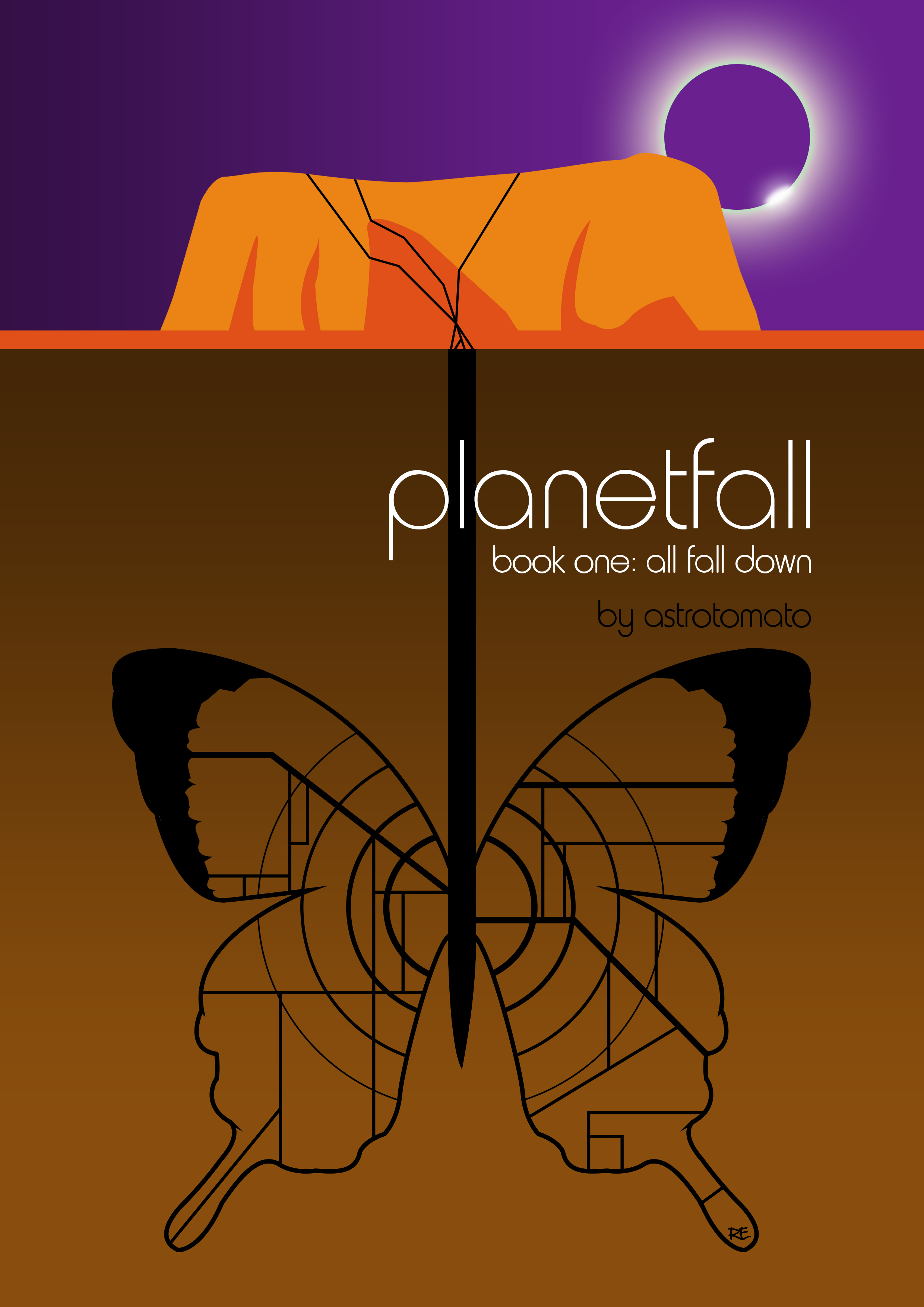
Well, book one is published! I still owe a huge debt to the cover designer @moviessimple.

The feedback has been phenomenal, too, with really good reviews from customers on Twitter, the Facebook page I created for the book, and reviews on Amazon.

The reviews really help: every time I publicise the book with a genuine reader review, it helps sell another copy. Reader feedback is key to growing the buzz around the book. You read this kind of thing from other authors and artists, saying how grateful they feel to their readers or fans, and now I know from their point of view how it feels. I am indebted to the readers who have taken a risk with my book, and who have felt motivated to write a review. Thanks to each and every one of them.

planetfall book 2: Children of Fall is coming along well, when I have time to write (I’m now back in full time employment). I’m up to 70,000 pages, and finding that my early predictions are bearing out: this is going to be a big book. It will come in somewhere between 150,000 and 200,000 words. A typical book is around 70,0000-100,000 words long. At the moment I’m not prepared to edit it to fit into a 100,000 word size. The story needs to live and explore its universe. Once I have a full first draft, I’ll see what’s needed and what’s extraneous and kill my darlings appropriately.

The story is getting good feedback from my writing circle, too, and they are nothing if not honestly critical. They’ll rip something to shreds if it’s not up to standard, as well they should. That’s what critique is for.

  • Robocop fanfic

Some longer time readers of my blog might remember that I wrote some fanfic last year while I was unemployed. What was supposed to be a 1000 word piece on Robocop turned into a ~35,000 word novella. It’s still very raw and unfinished, with half developed characters and some plot lines that just fizzle out. I’ve been thinking recently of resurrecting it and finishing it to a reasonable standard (not highly polished) and making it available as a free ebook download. Just for fun, you understand. More news as and when.

Updates on applications to agents

  • Backpackers

Before Christmas I undertook some significant rewrites of Backpackers, following some very positive feedback from agents. I’ve sent it to 23 agents so far. Of those, about 7 sent personal responses saying that they really liked it, but that their agency was listing different kinds of stories at the moment, or that as much as they liked it, they couldn’t see where it fit into the current market.

I met an agent in October last year, who confirmed that if agents give a personal response beyond a standard reply, that it means you’ve got something good.

Emboldened by these responses, I re-wrote part of Backpackers following a lengthy response from one particular agent. The re-writes were to make the story more commercially acceptable. The character Jack Wolf has been boosted from a bit part in one chapter to being one of the two loci of the story (the other being Cath). He now starts and ends the book, and the thrust of the narrative is about him trying to find the backpacker, Cath Pearson.  This meant re-writing the first 2 chapters almost entirely, a later chapter where Cath originally met Jack (now it’s her 2nd time, completely ditching the character John, and re-writing the final chapter.

I remember about two years ago a good friend, whose mother is a successful author, asked me how I would feel if I had to re-write a story to meet market expectations, and move it away from what I wanted it to be. My answer then was the same as my approach to the re-writes: The story I want is on my laptop’s hard drive saved in a previous version. No one can change that or take it away. What happens to it after that, to make it commercially acceptable, doesn’t matter. After all, a piece of writing only becomes a book when it forms a bridge between author and reader. And if the story needs to adapt so it reaches readers, then that’s fine by me.

So where am I now?

I sent the re-written Backpackers back to that most friendly agent. She kindly re-read it and wrote back saying she was still on a knife edge about whether she should pick it up or not. Ultimately, she went with market conditions: there just doesn’t appear to be the demand from sellers (not necessarily readers) for the story type in Backpackers, so she passed on it.

Obviously in one sense, that’s hugely disappointing: to be so close to the next step to publication, only to have it pulled away. But I was struck by her email: “You can write,” she said, “and please immediately send me anything else you write in future.”

I might not have hit the bullseye this time, but I have an open invitation to submit work in future. And that’s ultimately good news.

  • planetfall

Following the really positive response to planetfall from readers, I’m wondering if perhaps the book is a little better than I think it is (it’s my first novel and full of technical problems). So I am having a second round of sending it to agents. I only ever sent it to 10 agents anyway, and perhaps should have persevered a little more. planetfall never got the level of positive response that Backpackers has, but I did get personal emails from agents saying they liked it and that (beware, deja vu alert) that type of story is missing from the current market. Which worked against it, of course, because sellers weren’t looking for those kinds of stories…zzzzzz. Sounds familiar :-/

I have told agents that I’ve already published the book, and have pointed out the marketing I’ve undertaken, and the reader reviews that it’s gained. In that, I think I’ve changed my approach to agents. I am treating the submission query as a business pitch: here is some product, it has some traction with the market, there is a marketing profile around it, it has already sold a few copies. I’m not sure what response that approach will get, but I think it’s worth trying different approaches beyond the “Here’s my book, please like it!”* that I was using in my first round of submissions.  (*not actual text, professional authors, don’t worry.)

Updates on me, the author

You might have noticed the last few blogs having a slight change: confidence. I am no longer someone who writes books, I now consider myself an author. I hadn’t quite conceptualised it that way until I read a recent DIYMFA newsletter.

It’s a subtle shift in thinking to an outside, but I think inside it suggests quite a radical shift.

My self identity now includes an acceptance that I am an author. This is what I am, this is what I do, this is what I will continue to be.

That means that I will prioritise writing before other things, in the same way that for 40+hours per week I have to prioritise work because I am also a sustainable development professional. I love doing that kind of work, it helps make the world a better place and it pays for my food and home. If being an author could do that to a level where I could survive, I would take the chance. (I already took a huge chance in taking redundancy from a well paid job in 2011 so I can write constantly for a year and improve my writing skills. That risk, that chance, paid off. I made it into an opportunity, the fruits of which are outlined above.)

Because I now think of myself as an author, I’ve started thinking of doing things that I never previously considered. For instance, I will be going to the London Book Fair this year. So what? Anyone can go, you pay £30, you attend. But this is different. Previously I’d considered it was for industry professionals only. Now. Now I consider myself an industry professional, and that I deserve to be there. It’s the attitude change that’s important.

I’ve started running promotions as an author for planetfall, too. The recent competition I ran to give away copies of the book was successful, and got me good feedback. People have said they can’t wait for the sequel. There is a sense of expectation on me as an author, which means I need to respond by being an author who delivers.

Creating community

A few blogs ago I said I would write a blog about creating community, and how important it is as an author. I don’t have time to do that at the moment, so in the meantime the best thing I can do is point writers and authors to DIYMFA’s online resources for building community:

http://diymfa.com/category/community

And remember, the best community you can have is joining a writing circle where you regularly take your work and receive critical feedback on it. Re-writing with external feedback is crucial to improving our writing skills and the work we produce.

As ever, I’d love to hear what you’re up to with your writing. You can contact me on Twitter at @astrotomato or by email on astrotomato@gmail.com Just say “Hi astro” if you like.

A bientot,

astro x

astrotomato's avatarastrotomato

To promote the launch of my first novel “Planetfall: All Fall Down” I am giving away two copies of the paperback in a competition.

All Fall Down is the first book in a trilogy. All Commander Kate Leland wants is to be promoted to General. When it’s handed to her on a plate in return for investigating the death of a scientist, she is plunged into self doubt. Is she up to the job? And why doesn’t the scientist’s death appear to be as simple as she was told? Before she knows it, General Leland is plunged into a race against time to save a planet and prevent a war. But is she up to the task?

Weaving together different plot threads set in cyberspace, on the surface of a desert planet, and in an underground colony, the first book in the planetfall series is scifi in the space opera…

View original post 272 more words

Competition time

To promote the launch of my first novel “Planetfall: All Fall Down” I am giving away two copies of the paperback in a competition.

All Fall Down is the first book in a trilogy. All Commander Kate Leland wants is to be promoted to General. When it’s handed to her on a plate in return for investigating the death of a scientist, she is plunged into self doubt. Is she up to the job? And why doesn’t the scientist’s death appear to be as simple as she was told? Before she knows it, General Leland is plunged into a race against time to save a planet and prevent a war. But is she up to the task?

Planetfall_cover_final

planetfall cover art

Weaving together different plot threads set in cyberspace, on the surface of a desert planet, and in an underground colony, the first book in the planetfall series is scifi in the space opera mould. It also mixes in a government conspiracy which readers of Tom Clancy or Matthew Reilly would appreciate.

Competition

To win one of the two copies up for grabs, simply answer the three questions below. Send responses either as a reply to this post (I won’t approve the posts until after the competition closes, so that your answers aren’t shown to others), as a Direct Message on Twitter @astrotomato or to my email address astrotomato@gmail.com

Questions:

1. All Fall Down is set on a desert planet, where there are important minerals in the sand. Which famous science fiction book (and later film) was set on a desert planet devoid of water and full of giant worms?

2. All Fall Down is available in paperback and as an e-book. Which platform/website is each available from? (Hint: check my Store.)

3. The final question is actually just a question from you: what was your book of 2012? I’ll collate the competition entries and produce a list of favourite books from you all. There’s no right or wrong answer, I’m just looking to share reading tips!

The competition opens GMT 21:00 on Friday 18 January 2013 and closes at GMT 21:00 on Friday 25 January. All entrants must answer the three questions. I will pick the winner, and my decision is final, even if it’s rubbish. UK addresses only for this competition. Family is barred from entry to avoid claims of nepotism. Entries will be put into a hat and pulled out in the dark. The winners will be announced on this blog if they agree to having their names published.

Good luck, astro x

A dollar badly spent (work in progress)

Hello. [blog update 07 August 2012]

In the interests of opening up my writing process, I’m posting a work in progress. The following text is from a short story currently called “A dollar badly spent”. It’s being written for a competition of the same name. I’m posting it so I can get feedback from a general readership, to inform where it goes next and help tighten up the writing so far.

I have to give some legal disclaimers before I go on. (Intake of breath.)

The characters in this story, whether human or mechanical, and any specific organisation names, are the copyright of Orion Pictures Corporation or Lucasfilm. That’s because it’s based on Robocop. I am using them in a non-profit manner. The story is mine though.

Right, enough legal gubbins. Here’s the first part of:


A Dollar Badly Spent

A Dollar Badly Spent


“Mr. Snyder, can you recall how it all started?” The journalist looked at the man in the faded dressing gown, ready to take down notes.

“I’d buy that for a dollar,” Bixby Snyder said. He fumbled with a pair of gold-rimmed spectacles, his geriatric hands shaking with the effort. A cough animated him for a moment, but the life quickly faded, leaving just the shine in his rheumy eyes as a hint of who he might once have been.

“Ah, Mr. Snyder, if we could concentrate on the story?” The journalist wondered if the man’s mind was going. On the table by the man’s chair was a jar of baby food. What did it mean? Teeth gone? Digestive problems? He made a note about it. Sometimes the small details were what brought to life a story.

“No no,” wheezed Bixby, “my catchphrase. ‘I’d buy that for a dollar’. You ain’t never seen my show on re-run?”

The journalist shrugged his shoulders and scribbled “Snyder – TV?”

“Course, you’re a baby. This was back in the bad old days.” Bixby appraised the journalist. “Look at you, so young. Why you here anyway?”

The journalist shrugged, “Assignment from my editor. Your date’s coming up next year. Early research for an article. You know, ‘End of an era’ kind of thing?” The journalist cleared his throat.

“Yeah, but why you here?”

The journalist shrugged. “Pop always said to pay attention to old folks.”

“Yeah, well maybe good advice. Maybe not.” Bixby picked up the baby food. He just held the jar in his hand and gazed at it. The lid stayed on. Behind the glass, on his chair, he re-arranged his faded dressing grown. “Let me tell you how it all went wrong.” He put the jar down, “How I went from millionaire to death row.”

*

I was lucky. Society was going down the pan. Crime everywhere. Police privatised. Corruption so normal no one bothered fighting it any more.

And I had this TV show. No one was sure if it was ironic, a bitter attack on the spiralling economic collapse or if I was the ultimate product of that society. But there I was, primetime. Surrounded by beautiful women and shouting my catchphrase every other minute, “I’d buy that for a dollar!” They were the best times.

It all came to an end when OCP was brought down. You must’ve heard of that. A new generation of police enforcement, the Robocop, uncovered evidence of murder, corruption. But he did something different. He broadcast it live to Chicago and from there it went viral. Things changed over night. The OCP share value plummeted so quickly that it was worthless within a few months.

The government brought all the police back under their control. Some politicians, somewhere, found some balls. You know about the televised trials, the express death sentences handed out. That’s all recorded history. Things are good now, it’s amazing how quickly you forget how bad it was.

Once OCP became worthless, the buildings and police assets were re-possessed by the government, and there was hardly anything left of it.

And there was nothing left of me. The new society didn’t want my kind of humour. Rolling in money of my own, buying everything for a dollar to show how little value life had left. Even I wasn’t sure at the time if I was celebrating that old culture or parodying it. Who knows? I was happy. The people who watched were happy. They took what they needed from it. So did I. I was rich. But when that new spirit of community appeared, of holding the powerful to account, the humour changed. I was everything they now hated. I tried to change, to keep up. It was like changing the direction of a road train at full speed. You either take a long time to slow and turn in a huge circle, or you try it quickly, flip the trucks and crash. That was me. Biggest RTA in television history. When I tried a live comedy show trying to buy the new government departments and trotting out my catchphrase, the network’s value dipped fifteen points. The next day I was fired. I was furious at the time. In retrospect I would have done the same thing as they did. I was now dead wood, an embarrassment.

I still had my money, most of it. Takes a while to change your spending patterns though. You get used to being able to buy what you want, do what you want. Being out of work with no income was a shock. I hid from it for a while. Had this store of drugs. And the women were still around. I still smelled of success, you see. People love that smell, the aroma of power. Of course, when the drugs ran out, so did the women. And my money was going fast, too.

A year later, OCP went up for sale. I hadn’t worked for months. I was desperate. I went along to the auction. There was no one else there. Collective amnesia, I think. Everyone just wanted to forget about what Chicago had become. Now, at the auction the judge looked at me, sighed and said, “What are you willing to bid?” You know, just like that. Kinda tired sounding. Weary.

Half-heartedly I shot back, “I’d buy that for a dollar.” It was meant as a joke. I just wanted someone to recognise me, you see? A last shot at fame.

He banged his gavel and that was it. Suddenly I was the new owner of OCP for a dollar.

*

“Sorry,” the journalist interrupted. “You owned the entire company? For a dollar?”

“A bad dollar. Worst I ever spent. Gotta remember back then, a dollar was worth a lot to some.”

“And what, you got the employees, files..?”

“Nah,” Bixby said, “lemme tell you what I got. Damn thing put me in here.”

*

I left that auction house thinking nothing more of it. Signed some forms, you know how it is. Legal sale, all of that. Walked home. You had to walk in those days. Public transport was all gone. My car had always come from the TV station; I didn’t know how to drive. Fortunately the auction house was in the financial district and I only lived ten blocks away. I owned my property, one of the few who did. It was an apartment in a converted hotel. Still had some of that early twentieth century charm. Like Hemingway crossed with Art Deco.

Took me a while to notice the sound.

I’d been walking in a daze. Despite the drugs and the lack of work, I was still thinking about new characters, new acts. It filtered in eventually, the sound I mean. With every step I heard this kinda wheezing-clanging sound. Eventually I just had to look round, see what it was. You still got punks then, kids looking for trouble. Though most of them, even the punks, had been caught up in the great ‘work reform’. But they still gave you trouble from time to time.

I turned around and there it was. An ED-209. Following me at a distance of fifty feet.

You ever hear of an ED-209? Think about a metal chicken. Take off the head and neck so it’s just a body. Then turn its wings into moveable machine guns. Oh, and a short temper. That’s the guy. Autonomous law enforcement robots they were. You’d never see the like now. It’s genetically modified slave animals. But back then robots were the big thing.

Well I tell you. I looked this thing in its black shiny face plate. And I was terrified. You look one of those in the face you have maybe twenty seconds to start being nice or… Those guns ain’t for show. So I was looking at this thing and quailing. And I swear. It put one metal foot forward and pawed the ground. Like a dog, begging for a treat. Pawed the ground, made an awful screeching noise. And then it rocked, just like a puppy ready to set or git.

Never saw a more surprising thing.

“What d’you want?” I shouted.

It just played one word from its pre-recorded phrases, but it was enough. “You,” it said in that menacing voice. The end of the word kinda dipped, because it should have been followed by, “have twenty seconds to comply.” But the ED-209 just played the same bit, communicating as much as it could with a limited vocabulary.

“What do you mean, me?” I was shaking, I remember. Hid it though, didn’t want to show weakness to this thing.

It moved forward and dropped its head. Bowing before me. It said, “…comply,” when it bowed.

Well you could have knocked me down with a feather. The streets were empty, thank goodness. It was a Sunday, most people were at home, with their family. Some had started going to the churches, which had re-opened.

If that thing had had eyebrows, I swear it would have looked at me from under them. I couldn’t say no. Damn thing looked so pathetic.

“Did I just buy you for a dollar?” I asked it. It couldn’t answer. There wasn’t the vocab recorded in its memory. But it nodded. It knew enough to do that. I wavered. What the hell was I going to do with an ED-209? They’d killed so many people before they were taken out of service. And they were only in service for a couple of months.

“Gonna shoot me?” I asked.

“…comply,” was its answer.

“OK,” I said, “you can come home with me.” Well it just jumped up at this. Just like that puppy I mentioned earlier. As if I’d said, ‘walkies’ or was about to throw a stick. For some reason it stayed fifty feet behind me. Can’t imagine what its programming was up to at the time. Damnedest thing I ever saw.

For the next four weeks I got used to having it in the courtyard area of my apartment. I even fixed up a shelter for it, to protect it from the rain. I’d watch it sometimes, from the upstairs window. My apartment went over two floors, you see. Ground floor was for the kitchen, and most of it taken up with the lift shaft for the apartment block. I’d got a discount on the apartment because of that, and the ground floor space. My apartment proper was on the first floor. From there I’d look out the window at this robot in my yard.

It patrolled. Imagine that. Industrial killing machine ran regular patrols of the courtyard. Even saw it shoot a pigeon once. Can’t say I was too bothered. Even made me laugh, and I was glad of it at the time. I wasn’t seeing friends or colleagues. There was little pleasure in life. Watching ED-209 obliterate that pigeon in a cloud of feathers was the funniest thing I ever saw.

That was what gave me the idea. The one that led me to death row.

*

The journalist interrupted again. “Sorry, Sir. Do you have a picture of this thing? This,” he checked his notes, “Eddy 209?”

“It’s E.D., like the initials. ED-209. No, but there’ll be some on the internet. Most of the case file is on there. Surprised you haven’t done your research.”

The journalist flushed. He’d assumed this was going to be a boring assignment. Interviewing some crazy old guy in prison who was about to die. And it was only research notes anyway. When the execution went ahead next year, it would be a bigger affair, more experienced journalists would take the centre stage and claim credit for the articles.

“I’ll look them up, Sir,” the journalist said. “So tell me, ah. You had this thing in your courtyard and what? It got out, ran amok, killed people?”

“If only it had been that simple,” said Bixby, “I could have sued the manufacturers. No, what happened was this.”

*

Eventually OCP’s final assets were delivered to my house. It amounted to technical files for the ED-209, and some expenses claim forms. I gave those straight to my accountant, and he found a way to claim a couple of hundred thousand dollars against tax for me. That kept me going for a while and gave me the seed money to start a new business.

Yes, I’d had a business idea.

Before I took up comedy I’d been a computer programmer. I could still remember most of it. I was rusty, of course, but it was still up there. I started leafing through the technical manuals and they showed how to program the ED-209. By this time we were friends. It was summer and I was spending a lot of time in the courtyard, keeping myself brown. The ED-209 stood by me, and I started interacting with it when I had to move its shadow from my sun. Pretty quickly I was talking to it about all sorts of things. I didn’t think it would understand. It was just the only thing I had to talk to. And for the first time in my life, the first time I had someone to talk to who didn’t talk back, want my money or drugs or tell me what to do.

At one point I considered sticking a woman’s face on it, but that idea went out the window very quickly. I was starting to enjoy my solitude, starting to enjoy not having someone around, a human. Seeing another person’s face would have spoiled it. But I did dress up the ED-209. Put a little sun cap on it, gave it a little bit of personality. It didn’t seem to mind.

During those long hours, long days outside in the courtyard, I started teaching it some manners. Like not suddenly opening machine gun fire on squirrels bounding through the yard. Damn thing scared the crap out of me more than once doing that. And it could serve me drinks. I had to set them up, put them on a tray. There’s only so much a machine can do when it has machine guns for hands. But it could stand there holding the tray wedged between its gun barrels.

Leafing through the technical manuals I came up with some ideas.

There was a nostalgia movement starting, the older generation getting interested in old films, music, that kind of thing. Kids wanting to have some artistic expression, going to these cinema nights put on by the oldies. I went to one, in disguise. There was still antipathy towards me. I watched television, saw the new satirical news shows, comedy programmes. They lampooned me, and well they should have. Each passing generation needs to make a fire break from the worst excesses of the last. I didn’t mind, you know. I was starting to have my own nostalgia, too.

At this cinema night, someone had rigged up an old machine, I think it was a Blu-ray. There was a projector screen, too, with a tear down one side, and stains on it which the old timers had done their best to wash out. They pretty much disappeared during the darker parts of the film. But not during the parts with lighter colours. It was the first thirty minutes where I got my idea.

The film was the Empire Strikes Back.

*

“Sorry to interrupt again,” the journalist put down his stylus and adjusted his seating. “I think I know this film. Late twentieth century, right?”

“That’s the one.”

“Don’t tell me. The one about the Enterprise?”

“Ah kid. You people make the same mistake over and over. That was Star Trek. This was Star Wars.”

“Damn it, I knew that,” the journalist scratched his stylus across his electronic notebook. “Crazy old films, looks like they were all made with a toy cupboard.”

“Well, back in them days they still used some puppetry, and mechanical animation. Before my time, too, before you make any smart comment.”

“Not my place to judge, Sir.” The journalist checked the wall clock. There was only thirty minutes left of visiting hours. “Could we maybe get to the part where things go wrong? Just I’m being kicked out of here, soon.”

“I’d gladly swap places with you, son.”

The journalist gave a nervous smile and stayed quiet.

“Yeah. So, where was I?”

“Something about programming and old films?”

“Oh yeah. So I went to this screening…”

*

The film gave me an idea. Old timers like me were misty eyed over the special effects. Kids were real critical at first until the old timers explained the technology and such. Then of course you had this one kid says, “Let’s make our own.” Just like that. Let’s make our own.

Got me thinking. New society, new jobs, economy starting to move. Not me, I was unemployed, but solvent enough, though starting to look at a danger zone. It’d been a long time since I’d seen those films and they brought back feelings of, what? Innocence, I guess. How I felt when I’d watched them as a child. Not exactly nostalgia, more a feeling that everything would be alright. Childish thoughts, I guess.

With those childish thoughts came a similar emotion. Wonder. And wonder is like a virus. It moves from emotional state to activity far too easily. I started wondering. If they can make their own Star Wars vehicles, can I?

Well arriving home I went to sit in the court yard to enjoy an evening drink. And then it struck me. ED-209.

I worked hard, long long hours. First the programming, and then the costumes. Took me a week of hard work. And you know what? I really enjoyed it. The programming came back to me pretty quickly, considering the break I’d had. The costumes were the harder part, but I had experience from my early days on the comedy circuit. After those long, long hours, I was ready to start my new business venture. But I needed a launch event.

I waited another week, tested the costumes. Ran a few dress rehearsals. Remember, I was still a professional performer. I was used to scripting, rehearsing, going into costume, make up.

Eventually it was time for another film screening. This time the follow up, Return of the Jedi. It was perfect timing.

The screenings were in the evenings, when everyone was locked up in their houses. Despite the general lack of punks and the uplift in the economy, people were still in the habit of staying inside at night. That whole ‘reclaim the streets’ thing hadn’t yet happened. So I was able to travel to the screening without being spotted or stopped. It was held in a backroom which you had to access from an alley way. I’d love to destroy your mental images, but this was a typical alley way. Overflowing dumpster, puddles, stains. A creaking old fire escape running down one wall. And this crappy little door with a home made sign, “FILM NIGHT!!!”

I made sure I was last to arrive. The ED-209 I left outside, and my costume I hid behind the dumpster.

I went inside and settled into the screening. There were maybe thirty people there. A few more kids this time, one or two more old timers. Some of the kids had brought along their first attempts at model making. One of them had his computer and was showing off an animation he’d done. They were all pretty good. Just as I got inside, about to take my seat – one of those fold-up metal chairs so popular in community halls – one of the old timers called everyone to order.

“Now here this,” he called. He organised the thing, so I think he fancied himself a Master of Ceremonies. “Now here this,” he said and tapped one of the metal chairs with a pen. Clonk clonk clonk went the sound. An empty metallic noise. Everyone quietened. The only sound was a coffee machine, going through its final slurping sounds, waking up the air with those bitter aromas.

“Tonight these fine young men have shown us how we can make capture the glory of the old days. Make our own entertainments. But I have a special surprise for you.”

I sat there, suddenly nervous that I’d been found out. Had he been outside while I’d been looking at their crappy little vehicles and animations?

He walked over to a table in the corner which was covered with a cloth. I think we’d all thought the same thing. This backroom had obviously been cleared of whatever it stored. It was dusty, there were cobwebs in the corners. You know, it was a place that hadn’t been animated for a long time, except for the few movie screenings they’d held so far. The smell of dust still dried the air and tickled the nose. So we’d all ignored this table. Figured it was still storing something. The cloths covering some old piece of equipment.

Well not so. The self-styled MC whipped away the cover. “Ta-da!” he croaked. He was older than me at the time. Probably in his 70s, I’d say. His “Ta-da!” reveal was as graceful as a rheumatic dog clearing its throat.

There was stunned silence. The kids looked on, eyes wide, whispering to each other.

The old timers squinted, reaching for their glasses. They’d all been wearing their close-to glasses and had to swap to their distance ones.

The MC guy, he looked over the room waiting for a response. He waited and waited. His face turned from glory, the lines and wrinkles stretched back to an almost child-like sheen. But as long seconds passed and no one spoke, they sagged and the skin fell together again.

“What is it?” asked one of the kids. Of course, they’d never seen the like.

Eventually one of the old timers got up and walked over, sitting as they were on the other side of the room. “Where the hey-all you git that?” he asked. One of those southern gents who’d moved up to Chicago shortly after the coastlines were swamped by rising sea levels.

“Had this in storage the last six decades,” the MC said. “Used to belong to my pa.”

“Sorry, what is it?” this kid asked again. I stayed quiet, trying to figure out the right moment to introduce my own surprise.

“This here’s a Scout Walker,” said the MC.

“An AT-ST,” said the old-timer who’d gone up to look at it.

“A what?” one of the other kids had stood up, and soon they’d all gone to crowd around.

I took this as an opportunity to sneak out and suit up. I couldn’t have asked for a better opportunity, all those kids crowding round to see some original Star Wars toys. The door creaked a little when I opened it, but it was lost in the sounds of reminiscing and excited questions. Some things don’t change. Comedy changes. Parody and satire change with politics, and the target of a joke shifts depending on who’s powerful at any given moment. But you put boys and toys together, and it doesn’t matter what age you’re in. Could be 1784 or 2046. While they played with that faded lump of plastic and some of the other little figures and toys that old man had brought in, I snuck out.

I pulled on the costume behind the dumpster. Mostly I was wearing. The trousers with a stripe, the waistcoat, shirt. I was wearing a light jacket to hide them, so I took that off, put on a long green coat. Closest I could get it. The ED-209 I woke up. It rose on its haunches, its little servo motors whirring.

By the time I got back inside they’d all settled down and were just starting the film. I bided my time. We watched the Jedi return, the battle on Endor, the Death Star blow up again. Before any of the conversation could descend into the usual conversations, I stood up.

“Er, hey,” I was at the back of the group and wearing a long green coat.

“Who are you?” said one guy.

“I was here the other week, for Empire.”

Blank looks.

I fiddled with the coat buttons, each one popping out of its little slit like I was shelling beans. “I, er…”

I didn’t get to finish. One of the old timers shouted out, “What the heck you doing man? You some kind of pervert?”

“No, no,” I protested. I got the last button undone and shrugged off the coat.

Everyone tensed. The old timer had obviously made them feel like I was about to expose myself. Just what I needed. No job and facing a misdemeanour charge.

Finally one of the kids said, “Cool.”

I was dressed like Han Solo.

“Hey, nice outfit man.”

I looked this second kid in the eye, “There’s more. I want you all to come outside.”

“What for?” The MC looked suspicious. I could tell what was happening. He’d ruled the roost all night. Trumped the kids’ efforts with an original toy. And still in its box, too, though the cardboard was held together with tape and had some moisture damage. And then shown Jedi, blowing the kids minds and generating enough nostalgia from the old timers that you could tell his little film night was secured as a regular thing, now. He was king. And then here was I, right at the end, with something new.

“Just come along,” I walked to the door and activated a little remote control I’d built. The alley way floated through the door on its molecules of damp and decay. And then everyone heard the wheezing servos and metallic thunk of something heavy moving. I was pushing fifty years old at this point, but I still managed a cocksure smile and a wink. You know at this age, sitting in prison, I realised how young fifty years old is. I know how it feels when you’re younger, twenty or something. Fifty’s ancient. But believe me, the energy you still have, the confidence. It’s your peak, really.

In the backroom, with the smell of alley way piss wafting in, I said, “Trust me,” and slipped out.

*

“Time!”

The prison guard patrolled the line of inmates. The journalist looked through the glass and glanced at the wall.

“Ah, come on. I need more than this,” he said through the grille.

Bixby looked at the guard, nodded, stood and folded his dressing gown over his chest. He smoothed his hair and held up a hand to the guard. “Come back next month, I’ll tell ya the rest.” He winked, a slow affair which involved a fold of skin loosening and retracting with some difficulty. Bixby shuffled away without a second look or a goodbye.

Another guard tapped the journalist’s chair. “Time to leave, stringer,” he said.

“But,” the journalist began.

“You heard the man. Come back next month. Or write to him. Old fashioned way, mind. They ain’t allowed on the internet.”

The journalist gathered his things and left the prison. Outside it was bitterly cold. Winter had come to Chicago and a bone chilling wind arrested any pedestrian foolish to set foot outside. The journalist hailed a cab and warmed his hands as the vehicle made its way back to his offices.

Something bothered him.

He read through his notes and started tried to work it out. But it eluded him. Whatever was scratching at his brain wouldn’t come out. He went home.

The journalist lived alone. He thought himself lucky to be able to rent a few square metres of room. Chicago was full of immigrants after the sea level rises in the south, and then the drying of the mid-west. People wanted to live further north where rain fell and there were lakes for fresh water. The centre of the country burned while the south drowned. It was the same across the planet. Deserts crept northward eating the fertile land, while coastlines were reclaimed by a hungry sea.

The journalist made noodles and sat on his bed, which was his only furniture. His clothes he kept under the bed. His entertainment was provided through immersion goggles. The walls closed in around him. At the foot of his bed the door to the room barely opened before it scraped against the frame. There was a groove in the door from years of openings. Down one side of the bed was just enough floor space to walk. A small sink unit stuck out from antique pipe work and next to it was a 2-ring hob.

How very much like a prison, he thought. Except I’m free. I can leave whenever I want.

The journalist looked around again. This was how everyone lived now, in all the big cities. The rent was extortionate. Most of his salary went on keeping this place. There was always pressure from immigrants, and landlords held all the power. He’d once a read an early twentieth century book about a similar situation where a man had discovered some extra space behind a false wall. But the journalist had tapped every wall of his small room and found nothing. He put his hands behind his head and thought over Bixby Snyder’s story.

It struck him then what the flaw was in Bixby’s story. Not that he knew the ending, though he’d already put a request in to meet the following month. The flaw was this. That coming out of an auction house, this ED-209 police robot had followed him home. How could that be? Why hadn’t it been acquired by the government? How was it loose on the streets, in an auction house, powered up and active? Especially after Bixby had said the robots had killed so many people.

The story was starting to unravel. The journalist pulled out his computer and stylus and started making notes. Satisfied, he slept, while trains rattled past the tiny, cupboard-sized apartment and rain started to fall outside.

Writing exercises

In this post I want to discuss writing exercises. I also include one of my own writing exercises.

Imagine you want to run 10km, but have never run before. What do you do? Put on your training shoes, go outside and just run 10km first time?

Clearly, no.

To run 10km we need to train. We start with short runs, interspersed with walking. Gradually we build up our running distance.

And we also do something else. We build up our upper body strength and our core strength. Our upper bodies help act as a pendulum to propel us forward. And all good running should come from our core muscles.

It’s the same with writing, too. We can’t just write a novel straight off. We need to build up our strength, not only in novel writing, but in other aspects of writing. Things like dialogue, plotting, maintaining a story arc, foreshadowing, characterisation, and so on.

Of course I learned this the hard way. My first attempt at writing was to dive straight into a novel, without really know what it was about or how it was structured. And I had no fiction-writing experience to help me. That first novel was a creation story, about how a world came into being. It never went beyond 67 pages.

My next attempt at fiction-writing was my first novel, All Fall Down, the first in the planetfall trilogy. I’ve lost count of the number of times I started, deleted and started again on this book. But one thing started to become apparent amongst those re-starts: I needed to practice different parts of my writing.

I took a break from that book to write a short children’s story, which had a story arc – it told the surreal tale of a young girl called Ayla who suddenly found herself on a bus, not really knowing how she got there. Her quest is to find a ticket so she can stay on the bus, and to evade the dreaded Bus Conductor. I was lucky to have a friend illustrate the book for me. (By the way, you can download a black and white Kindle version of the book here: Ayla’s Journey.)

Having plotted a story over seven chapters or so, I went back to planetfall. I’ve blogged before about my attempts at storyboarding, and how I became more proficient at it.

There were other writing exercises, too.

Dialogue is a particularly weak point of mine. I love writing flowing description, and I’ve become pretty good at pinning it to a story structure. But relating characters’ thoughts through dialogue is a hard skill to master. So I set myself some writing tasks – short stories comprised, mainly, of dialogue and little prose. One of those is below (Frankenstein).

I also set myself tasks like this:

  • write a story in 1 side of A4 (actually this is how planetfall started in the first place)
  • write a description of the interior of a church in 1 side of A4, but importantly fill the page
  • write something which generates an emotional response in under 500 words
  • write biographies of characters for stories I’ll never write
  • create characters from the people around me in a coffee shop
  • create characters so different from the way I think, that I hate them, then write a short story about them and make them do and say things I don’t agree with (this can be as simple as voting the opposite way to my own political preferences, as normal as hitting people when angry or as extreme as murder)

These writing exercises are akin to going to the gym and doing sit-ups or lifting weights. They build our writing muscles in different parts of our creativity.

At the moment I’m writing a short story about a character from the film Robocop. A sort of, What happened next story about one of the minor characters. I’m constrained by the world and character someone else created, which means I have to find a way to understand an established character and write something true to them and true to a unique story.

If you’re just starting on your writing journey, bear this in mind. Writing a novel needs training. Training means distractions from your novel. It’s a long journey. And at the end of it, you’ll be fitter, creatively, than you’ve ever been.

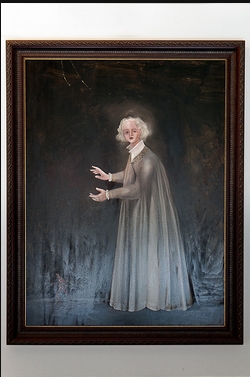
Here’s a writing exercise. It’s based on two men in an art gallery, looking at a painting called The Psychoanalytic Puppeteer Losing His Mind (shown below, not my photo)

Image

Frankenstein

“What’s that creepy girl doll with the man’s body?”

“Painting of me, darling,” says John.

“Says ‘George Condo’. Listen, you know what we talked about? Will you do it?” Seb looks at John. Museum visitors move around them.

“That’s what it reminds you of?” John looks side long at Seb and squints.

“It’s been a year, John. Our anniversary.”

“You’re Brian Sewell, now? Painting as sexual identity?”

“John, please.”

“Can we not talk about this here. It looks like my grandmother being caught doing something she shouldn’t.”

“As opposed to you not being caught doing something you should.”

“Can’t you just… Fine then.”

Seb turns from the painting. “Tonight?”

“When the time’s right.”

“For God’s sake, John. There’s no right time. You just have to do it.”

John clenches his hands. He snaps his head to Seb. A group of older people stand next to them and comment on the painting.

“Look, it freaks me out is all.” He speaks through tight lips.

“It freaked me out when I told my parents. I still did it.” The group moves away. John and Seb are left standing alone.

“I just don’t wan’t them to think of me as some sort of freak. Like Frankenstein or something.”

“You’re just coming out, John.”

“You’re all so grown up. I feel like I’ve a child’s head on an adult’s body. You know what my Dad said.”

“Yes, ‘Don’t mind ’em but wouldn’t have one in the house.’”

“Will you be there?”

“I’ll look after you. Creepy doll’s head and man’s body and all.”

“Alright.”

“Who’s the next painter?”

“Says, ‘Francis Bacon’.”

“Oh fuck.”

[end]

Contacting agents

I recently finished my 2nd novel, Backpackers. It’s a road journey / coming of age story, about a 20 year old Australian girl who struggles to come to terms with her father’s death. She leaves her home to backpack around south east Asia, and her experiences there highlight her inner struggle to cope with life as a single-parent child.

Now that the book is finished, critiqued by my writing circle at every step of the way, and with feedback from some amazing readers(*), I’m about ready to send it to literary agents.

This is the second time I’ve sent a manuscript to literary agents. Last year I sent an early draft of my scifi novel, planetfall, to two agents. That was a test run, really. I didn’t know if the novel was ready – I hadn’t really developed my internal editor that well – and I was lucky to receive lengthy feedback from one agent giving positive feedback, but asking for it to be developed a little more.

This time I feel more confident about my manuscript. Backpackers is a stronger book. It’s really benefited from being critiqued at each stage of the writing, and I’ve really benefited from opening up my writing process. planetfall was written in its entirety before I showed it to anyone. Backpackers had just 3 chapters written before I showed it to others. And I received some very awkward questions which made me question deeply my main character’s relationship with her father, which lies at the core of the book.

Contacting agents is now a more confident affair. I have no idea if they’ll like it, but I at least am proud of the book. It made me cry while writing it, and cry each time I edited it. I was pleased when readers wrote back with the same comment – that they cried at certain points, that the book had emotionally affected them. There is no greater compliment I can think of, that something I wrote affected people busy with their own lives, enough to prick their eyes to tears.

And so to agents. I’m reading through their websites, despairing at the ones who insist on printed submissions, and delighted with the ones open to email submissions.

I’m currently developing my synopsis and cover letter. And when I have a few more readers’ comments in, and a final polishing edit, I’ll be ready to submit Backpackers to those who can make or break. But whatever those agents decide, I am proud of my little book about young adults travelling in exotic climes and experiencing the growing pains that make us rounded, mature adults. It’s fun, traumatic, exciting, tense, emotional and ultimately affirming.

I hope one day you get to read it, too.

(* many of the readers were sourced on Twitter. They are people I don’t know other than through their tweets, which has meant more objective reader feedback than friends may give. I would like to pay credit to those who volunteered to read a stranger’s book and give honest feedback, and by dint of this, point out how amazing Twitter is when used properly.)

Flash fiction – Austerity Measures

Today I’m giving away a short story – or “flash fiction” as it’s called in the writing industry (writing under 1000 words in length).

This is the first story in my short story collection, Dark Things. It started off as a treatment for a longer book, and evolved into a very focused, intense work about child abuse (it wasn’t supposed to be like that, I just followed the writing).

I hope you enjoy this work of flash fiction called “Austerity Measures”.

Austerity Measures

The kitchen light flickers and makes a dink sound. You’re not supposed to look at it too long. It burns your eyes, Mam says. But he still does. The spots it leaves are like secrets which only he can see.

“Upstairs,” she taps her cigarette.

“Do I have to?”

“It’s signin’ on day.”

“So.”

“Yuh know how yer Dad gets after Job Centre.”

“‘E’s not me Dad.” He picks up his water and leaves the kitchen to its layers of cigarette smoke. In his room he gets under his bedsheets, which tent over him, and he imagines the light, the shining world.

He hears the front door open; slam. “Wha’s fer dinner?” It’s the man. Mam says not to call him that, so he only says it in his head now.

A light escapes his bedsheets.

“You’re drunk.”

Silence, then he hears the second-most hated sound in the world. It’s followed by the first-most hated sound: his Mam crying out.

He does the hiding thing where he closes his eyes and imagines himself underwater with the light, like he’s down in the ocean trenches on the programmes they watch when the man’s out. Deep and far away.

Under the bedsheets the voices are muffled. But in the small house, he can still hear. “Ge’ dinner on,” from downstairs. “Where’s ‘e? I said where is ‘e?”

“Upstairs.”

“GET DOWN ‘ERE.”

He sinks. When he can’t sink further, he opens his eyes. The shining world fills them. He puts his face to its surface.

“Where’s the sauce?”

“Couldn’t afford any.”

“Wha’?”

“It’s hard wi’ what government give us. Wi’ food prices an’ all.”

“Everything’s fucking my fault, en’t it? Where’s ‘e? GE’ DOWN ‘ERE I SAID.”

Each word becomes a depth charge, waiting for a wrong move. Warmth leaks out and yellows the sheets. Water leaks along a cheek. He crawls away from the dirty stain he’s not supposed to make and drops to the floor and wriggles under the bed. The light is in his eyes and inside him. It’s safer under here, like at the bottom of the sea. It’s easier to hide. A battered old action figure looks at him with dead eyes.

“Din’t say it’s your fault. I try.”

“Berra’ off eatin’ down’t Club.”

“Go then!”

He hears the hated sounds. Second-most. Firstmost. Cringes.

There’s a thudding sound, and his bedroom door explodes open. He holds his breath.

“Tol’ you ‘uh ge’ downstairs.”

“Leave ‘im, will ya?” Desperate.

“Fuckin’ ignore me?”

“If you touch ‘im…”

“Aye, yer’ll leave ‘us! Gerron wi’ it, then. Where are yer?”

The man whips the bedsheets away.

“Fuckin’ pissed the bed again? Eight year old, pissin’ bed?”

He hides the light inside so the best person at hide and seek would never find it. He is deep in a trench, deep under the sea.

Deep underwater, he lets a bubble of air escape, draws another. It’s soft like a gasp.

“There y’are. Hide from me, will ya?” The floorboard creaks, the man drops and looks at him with darkness in his eyes. The man’s breath is sour and ragged.

He follows the light inside him to deeper, deeper canyons.

The man reaches in and pulls him out. The bed scrapes along his head. Depth charges explode, spreading the darkness.

He keeps hiding in the light, deep, deep beneath the waves.

Above, a storm roars and thrashes and he sees the room spin around.

Deep down, the light is soft and doesn’t burn at all.

Bubbles burst from his mouth.

A whale sings far away, a sad and mournful sound.

The darkness closes in.

He follows the light inside.

Backpackers

I haven’t blogged about my writing for a long time. 


The reason is that I’ve been working on a new book, and have been involved in a writing circle which has vastly improved my writing abilities. All of my spare time has been spent on writing and critiquing other people’s work.


Finally, though, I have something to share. I’ve finished the first draft of a novel called Backpackers. It is a road trip / coming of age story, a long way from my usual science fiction. The draft is out with readers at the moment, and I’m eagerly anticipating their critical feedback.


In the meantime, I have a book cover for the novel, produced by whitefire-designs.co.uk What do you think of it?

Image

Link

Dark Things by astrotomato

Dark Things by astrotomato

My new book is a collection of five short stories. Each story takes as its starting point the economic recession and imagines what happens in different scenarios where social services are removed, there is little access to work or education, or – taking a very long view – the state moves to control our very biology to ensure a calm and orderly society.

Expect no happy endings. It is a collection of dark things.

Click the blog title to visit the Lulu.com page to order this book.

For those who have a Kindle or Kindle app, order the book at a much reduced price here:

http://rcm.amazon.com/e/cm?t=twitter0b8-20&o=1&p=8&l=as1&asins=B0078OR3II&ref=qf_sp_asin_til&fc1=000000&IS2=1&lt1=_blank&m=amazon&lc1=0000FF&bc1=000000&bg1=FFFFFF&f=ifr