Writing planetfall

Last blog post I talked about finishing planetfall book 1, and writing a synopsis prior to finding a literary agent. I covered my immediate feelings on finising the final edits – that the book will probably end up like thousands of others, lost in a slush pile or flat out rejected, and how that awakened a determination to fight for it.

In this blog I want to step back from the technical process of writing – character development, plot devices, and so on – and give a little insight into some of the materials I use for writing. Other writers may gain more from this than casual readers.

I normally start writing in long hand. That’s not to say I can’t write straight to laptop – I’ll come onto that in a later blogpost. After some experimentation, I’ve found the following work for me:

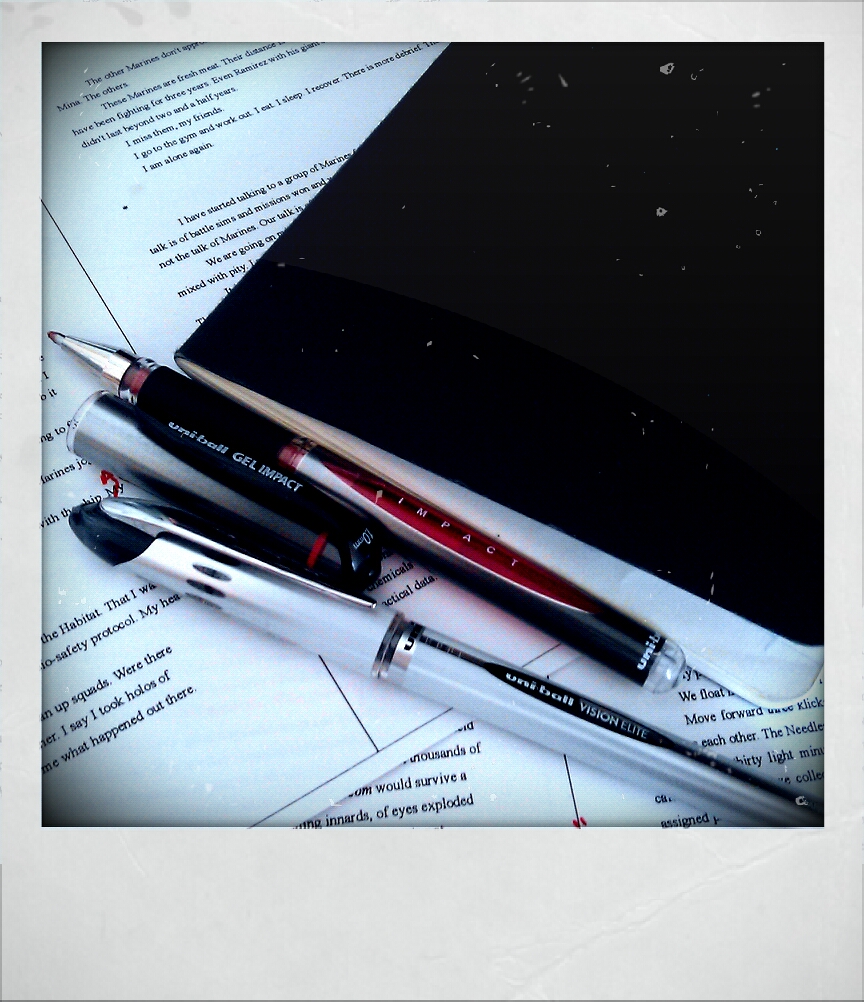
  • Uniball black gel pen
  • Moleskine notebook
Moleskine notebook and Uniball gel pens

Moleskine and Uniball pens

The Uniball gel pen took some finding. I used to write with biro, and of course if I’m caught without my writing materials and feel the need to scribble, I’ll still use one. When I discovered I preferred starting stories in long hand, I realised immediately that I’d need a comfortable pen to write with.

I have very messy handwriting, and I’ve always found biros too skinny and slippy for comfortable writing. The thin stick of the pen casing digs into the flesh between my thumb and forefinger. The small circumference makes it hard for me to keep a reliable grip. And the easy rolling of the biro’s ball makes slips across the page far too easy. I knew if I was going to manually write stories that I’d need to change this.

I don’t remember how I found the Uniball pens. I know I bought a couple of different pens from a local stationery shop, and chose them all for the thickness of the barrel. The ink-type and nib had no bearing on the decision. The gel ink of the Uniball stood out immediately. It feels to me (and this may not be real, just perceived) that the Uniball has better traction on paper, that there is some resistance. The ink also comes out in thicker lines, which helps to hide the drunk-spider scrawl that is my normal handwriting. The thicker barrel makes the pen easier to hold and more comfortable for a longer period of time. In short, it is a more satisfying writing experience.

Now, the Moleskines. You’ll all be rolling your eyes – so cliched, right? Well, yes, but then cliches come from somewhere, don’t they?

I bought a Moleskine due to a story I read about  a writer who could only write with Moleskines (read it here). I was fascinated. What were these notebooks? It was around this time that I discovered they’d gone out of production. A short while later there was a newspaper article – Moleskines were back in production. This was long before I was writing seriously, so I squirrelled the information away: at some point in my life, I would try one out.

When I started writing more seriously, and found that long hand was my preferred initial method of writing, I resolved to try them. To that point I’d been writing on A4 pads, top bound, flip up. I found them unsatisfactory. Now, I know some writers swear by them. They write with a pencil on A4 block. They write only on on side, using the block’s longer and broader expanse to give their hand room to roam & write and make notes. But I don’t write with pencils – for a start you have to keep sharpening them, which means carrying a pencil sharpener around. I would lose it quickly. And pencil fades and slips across the paper. No, not for me.

I tried, too, Uniball on A4 paper. While I liked the feel of the Uniball, I found the ink is too heavy and thick, and the paper too thin, so that you can see the writing on the other side of the page. I don’t write on one side of paper, it’s a waste of resources. And anyway, I was going to be out and about writing. I’d already decided that. There are too many distractions at home – TV, Wii, internet (internet!) – so I remove myself to cafes to write. Somewhere where there is nothing left but the page and the pen and what’s in my head. Carrying an A4 pad around would be too bulky and awkward.

It was on a trip up the Lea Valley (north east from Greater London) when I was volunteering with Friends of the Earth that I spied a pack of 3 Moleskine notebooks in Liverpool Street Station’s W H Smith. I bought them, put them away, went and did my volunteering (for the Climate Change Act, as it became), came back to London after a pint and my first ever pickled egg, and put them away. And promptly forgot about them. It was over six months later, in January 2008, when I decided to go on a writing break to the Isle of Skye that I dug them out.

And was hooked.

Their covers are made of a rough, black card-like paper, so they look a little mysterious, like they could contain anything: diaries, stories, poems, sketches of sweethearts and brawling drunks. They have rounded corners which don’t get caught in things. The paper is thicker and yellower then A4 pads. The Uniball gel ink clings to the paper and draws the pen across its surface. They are a construction made for writing.
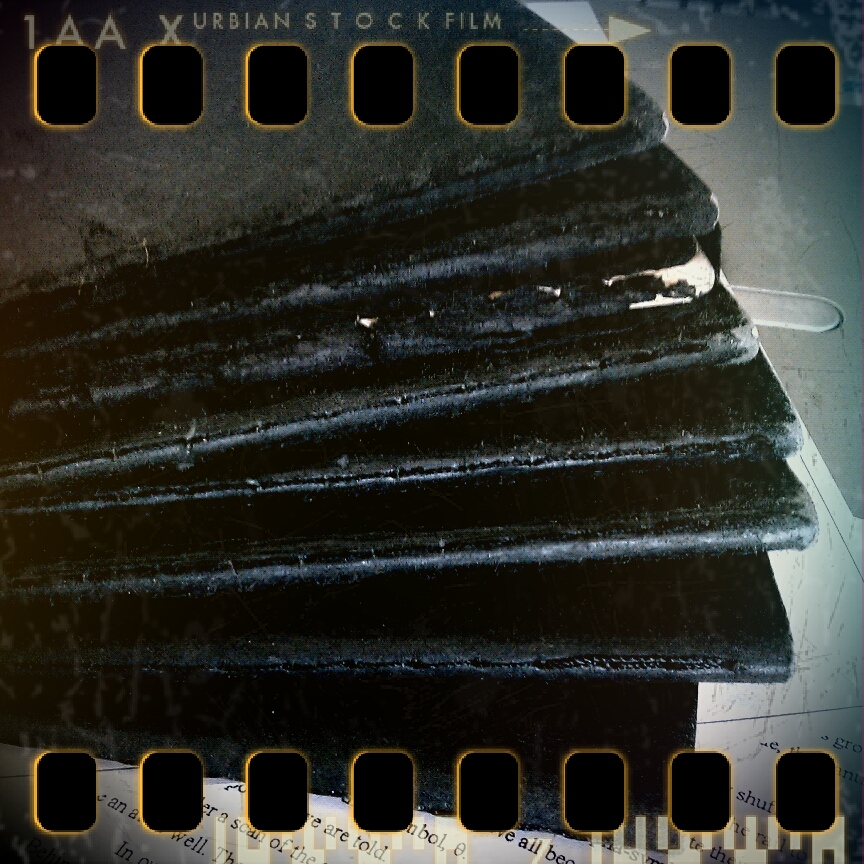
Stacked Moleskine notebooks

My Moleskine notebooks

I have since filled 7 notebooks with notes and storyboards and thoughts and plans for planetfall and a couple of other short stories (Ayla’s Journey, First Things First, The Boy). The picture above shows the 7 filled notebooks and the current 8th, and the picture below shows the first page from the first Moleskine I ever used, including my first attempt at story boarding.
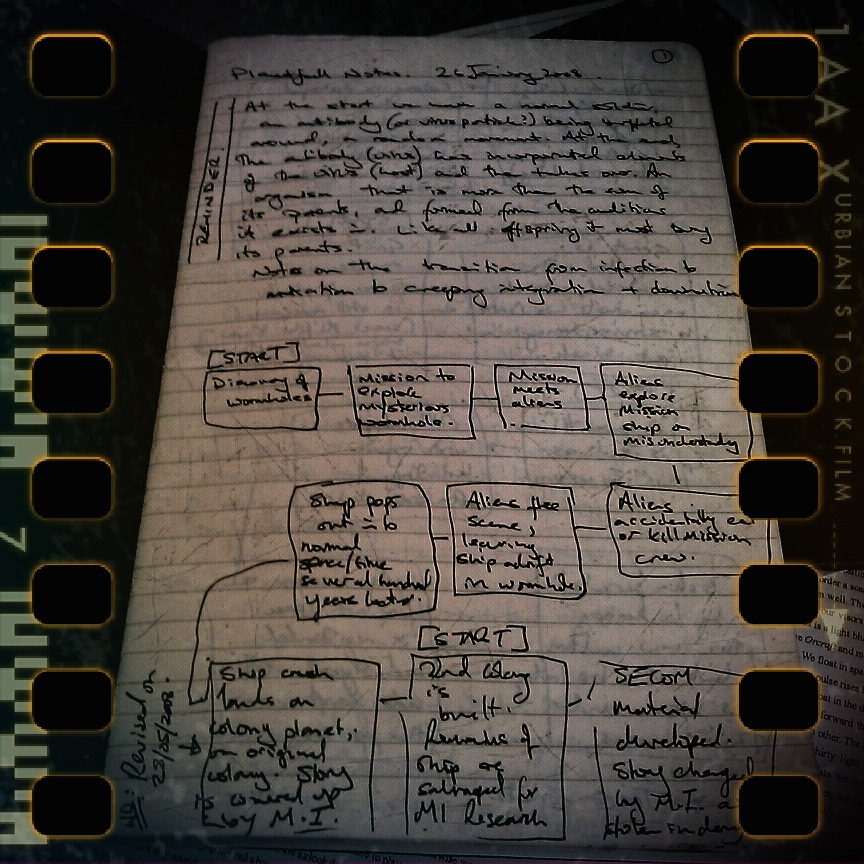
Moleskine notebook opened to writing page

The first page of the first Moleskine notebook, plus my first ever story board

I now carry my notebook and pen with me pretty much all the time. There is always time to scribble something down, even if it’s a word, a short sentence, or just looking at what I’ve written, or the story board to fix the narrative in my mind.

When I write in the notebooks I record the date, time and place. Although it is not meant to be a diary, it gives me, of course, a reminder of where I was at particular times. Sometimes leafing through past notebooks makes me wonder why I was free at 14:52 on a Tuesday, rather than at work. In that sense it records some of the context of my life as I was creating this other place, this other world, these other people, these other events.

So there we have it. Uniball gel pen, Moleskine notebook. That’s how it all starts. Next time, a little something, I think, on transferring the writing to the laptop and how I go about editing the work.

planetfall & the MacGuffin

In the last blog I introduced planetfall book 2, its main protagonist (a space Marine), and the first-person approach it will take, with the Marine having no name: essentially the Unnamed Soldier.

In this blog I want to return to planetfall book 1, and talk about a specific plot element that helps drive the story. It’s a thing that many of the characters are either trying to find, or keep hidden. Sometimes this thing reveals itself, subtly, tangentially, metaphorically, but most of the time it is mysterious. At no point do the characters who are trying to find this thing ever get their hands on it.

This thing is the MacGuffin.

Alfred Hitchcock popularised the MacGuffin. He said that, “In crook stories it is almost always the necklace and in spy stories it is most always the papers”. It is the thing that causes the characters to run around. It is the thing around which events happen. And it is generally inconsequential to the plot of the film, despite being central to it.

In Indiana Jones land, the Holy Grail and the Lost Ark of the Covenant are the MacGuffins. Indy spends most of the film trying to get hold of these things. As do the bad guys! And then it turns into a race to steal it from each other. In Star Wars Episode IV: A New Hope, the stolen Death Star plans are the MacGuffin. In this scenario the good guys have them and are trying to keep hold of them and transport them to a safe place. It is the bad guys who are trying to get them back.

Often considered the most beautiful example of a MacGuffin is Rosebud, the last word of Kane in Citizen Kane, and it is the protagonist’s attempts to work out what it means that drives the plot.

So description aside, how is this applied to planetfall? What’s the MacGuffin?

I was inspired to write this blog post by graphic designer and bloopy sound producer Dave House (listen to his Reverse Engineer stuff), who tweeted me after reading just 10 pages of planetfall to say he’d “started reading it and is hooked after 10 pages. Mystery black blobs and fungal panspermia. Loving it.”

I started thinking back over my original intention for planetfall‘s MacGuffin: the black pods – because “mystery black blobs” is exactly how they started life. Without giving too much plot detail away, in planetfall the existence of the black pods is revealed to the reader very early on (another plot device borrowed from Hitchcock, but for another blog). The characters presented as the searchers in the story, the ones looking for something, are kept in the dark about them. During the course of the book they spiral closer and closer to coming into contact with them. But do they get them? Do they even know the pods are something to get?

As I wrote and developed the concept of the black pods (reverse engineered from the material secom which appears in book 2) I realised I needed something stronger as a MacGuffin; the black pods just weren’t working out in my initial planning and writing. I needed something elusive that would give the characters something to do, and continually keep them moving to other situations. So the black pods fell out of favour, and I developed another MacGuffin, which I will mention briefly below. The pods, though, in being abandoned as the story’s principal MacGuffin, refused to give up so easily, and acquired a life of their own – they were just too interesting to abandon from the story, and so turned into the driving element of planetfall‘s cyberpunk underbelly, a part of the story I had never planned or envisaged until it popped out one day in the ubiquitous coffee shop in Crouch End.

This is one of those wonderful artefacts of failure. I tried to make these black pods – analogous to the black box of technology and physics explanations – into a strong driving force for the main story, and failed. In failing, they rallied in my mind, coupled themselves to a character, Verigua, who had charmed its way into the story, and ended up creating a whole story line of their own. It was unbidden, it was unplanned, it wasn’t storyboarded, and I had a lot of fun and frustration and thrown-out writing trying to figure out how they actually fit into the main plot of planetfall.

I wanted to write about this failure-leading-to-success for any others reading this who are writing or thinking of writing a story of their own. Failure is a necessary part of success. You have to try things, work with them, and throw them out if they’re not working. Because sometimes in the act of “killing your darlings” (as a friend once put it), you find something more interesting and creative than you could have come up with on a blank piece of paper. Failure is an option; in fact it’s essential to success. But it has to be coupled with determination and keeping going. This is something that too few of us realise or are taught, I think. It doesn’t matter if you fail – it’s that you tried in the first place. But if you try and fail, and learn nothing, then you have truly failed.  If you try and fail and learn and evolve and learn (and maybe go back to it with something based on your failure) – ah well, then you’re a success. It doesn’t feel like it at the time, it just feels like you’re set up to fail again.

Back to the real MacGuffin of planetfall. On the first page of the book (so no plot giveaways) a character is killed. It is that character’s death, and the hunt for the killer, that is the real MacGuffin.

planetfall starts off as a sort of murder-mystery. It’s a whodunnit?. And like most MacGuffins, as I said at the start, it keeps the characters running around and having fun, while the other MacGuffin, the one that refused to go away, slowly and inexorably catches up with it.  How that happens – well, you’ll just have to read the book when it’s released!

So what about planetfall book 2? Does that have a MacGuffin?  Is there something the characters are chasing or trying to protect or steal or find or figure out? At the moment, even I don’t know. And it’s going to be fun finding out.

Creating the planetfall universe

In my last blog post I gave an outline of how planetfall came about – its genesis as a short story, as a writing exercise, and then its evolution as my own writing skills improved: the story of a Marine stretching to 200 pages, edited down to 35 pages, grown again to 75 pages, abandoned for a few years while I wrote a sub-plot, the realisation that the sub-plot was a book in its own right, and the eventual return to that Marine.

But how do you write a sci-fi book set one thousand years in the future, stretching across two books-worth of material (even if half of that has now been deleted)?

Some authors literally make it up as they go along. Or so they say. I often wonder how they develop complex characterisation and a realistic environment by making it up as they go along. I can’t believe there isn’t a little bit of planning in there.

My approach with planetfall started off like this – make it up as you go along. And I quickly realised that wouldn’t work. To make a universe realistic from the first page, the first paragraph, sentence – the first word – it has to seem lived in. It has to feel realistic to the reader. It has to feel like there’s an internal logic, even if the reader hasn’t yet discovered it.

I spent time developing a one thousand year history for planetfall. It starts from around 2050, covers humanity’s first foray to the edge of our solar system, and then its spread out into the galaxy. The major socio-political events are mapped out, the great technological turning points are described, and the artistic periods are mapped and named. Half-page to full-page mini stories, in the style of Wikipedia, exist to describe specific events that form the backdrop to certain characters. For example, Daoud, the Administrator of the Fall Colony, has several pages of character development. His story concerns a trip to Jupiter, and subsequent arguments with the shadowy Cadre which runs society.

For much of planetfall it should seem like references to the broader social universe are consistent – technology, feelings, cultures should all go to a common reference point, regardless of what the characters’ views are on them.

Sometimes there are points in planetfall where I realised there was a hole in history – where the story needed to reference cultural norms or events of the past which I hadn’t written. At those points I had to make decisions – do I make a throwaway reference and hope I don’t need to use it again, or do I take time out to flesh out the universe’s history?

In some cases – the trip Kiran takes out of system – I used throwaway references. The great thing with a galaxy of planets and stars is that you don’t have to return to them. With others – like the AIs and their levels and complexity – I had to sit down and figure out what they were, their characters and relationships.

The most important aspect of pre-writing development, however, is concerned with the characters. Characters in books need to be consistent (even if they are unpredictable, their unpredictable nature is at least predictable) so that the reader can form a relationship with them. In planetfall there are biographies for Daoud, Kate Leland and Sophie Argus, and lesser biographies for Win Ho-Yung, Djembe Cygnate and Doctor Currie – the six principal human actors of the story. Only one character has no developed character biography – Verigua, and that simply because the character wrote itself, and it essentially has no background. Kate, Win and Djembe also have drawings associated with them, which detail my initial thoughts on their view to life – are they people who look backward, who look forward, or who are happy in the moment?

For all the character development I carried out, characters still have their own life in the same way that sometimes new cultural reference points, historical events or places need to come into being to suit the story as it’s written. Djembe was the biggest surprise here.

I do not particularly like the character of Djembe. For many months I fought against the character and tried to make him less straight-backed and rigid and systematic. In the end I gave in and let the character write itself, and the writing became much easier. A salutory lesson in writing characters – they have their own life, they find their own place in the story, and regardless how much character development and universe creation I carried out,  the interaction between characters and environment always brought about story elements that I could never have predicted. Djembe’s antagonistic relationship with Verigua is one of them; Sophie’s fate is another (she had a different fate planned for her which I had to scrap when the story turned a different way).

There’s a common thread coming out here – sometimes the story writes itself, but only, I think, when the author has a deep understanding of it. I’m not sure if non-writers believe this. In many, many places of planetfall I do not feel I was in conscious control of the writing. Many times I would sit in a coffee shop (usually Costa Coffee in Crouch End) and simply read the story at the pace my hand was writing it. It was as new to me as a reader picking up the book for the first time. This is an amazing feeling, and I presume what people are referring to when they talk of their ‘muse’. When the story elements combine so well and are so embedded in the psyche that their immanence flows directly to creation of the story, bypassing the conscious mind and flowing straight from mind to hand.

This doesn’t happen without development and planning. And it also doesn’t happen without letting go of the story and characters and letting them interact on their own terms.

Some places in planetfall are completely planned – the sequence with Djembe and Verigua in the corridor was very carefully planned and measured and drawn – while others flow from letting go of the story – pretty much all of Verigua’s sections (bar the one just mentioned) and the events in the very last chapter (a complete surprise to me, and I almost did a little wee with excitement at one point when it went all 50s sci-fi B-movie on  me). However all of it exists within a framework, a story board I developed right at the start, which in around 20 frames tells the main story points from start to end: arrival on Fall, the trip to the surface, Kate’s travel through darkness, the arrival in the sky.

I guess the realisation I’ve come to is that I have a preferred writing style. I like to know what the universe is like before I find the story within it. Making up the universe is fun as you can put whatever you like in, and then the story can write itself, within a broad and flexible framework, over the top of it. And that broad and flexible framework has to provide enough room, space and air for the story to create itself, to write itself into being.

planetfall: genesis

planetfall – correctly written with a lower case ‘p’ and as one word – was borne out of a short story, and like most first-novels went through a long development process.

I treated the writing of planetfall as a self-education in creative writing. While writing it I tried many different exercises and approaches, failed more than I succeeded, then failed some more, went off on tangents, took breaks, became frustrated, scrapped pages and pages of material and generally found that auto-didacticism is easier to spell than to do.

The short story from which planetfall evolved is about a Mexican man looking back on the Mexican-American war around the time of the Alamo. It was a writing exercise in which I challenged myself to write a short story that had a definite beginning, middle and end, was character based, and which would fit onto one side of A4. The story was mostly dialogue, the Mexican man talking to his young son about what it means to be a man while he shaved his cheeks and shaped his moustache. I put this story to one side and moved onto other writing projects (I think some exercises on colour and motion).

Some time later I returned to the short story and thought it would be interesting to re-write the story from the son’s perspective, this time he would be a grown man thinking back to his father’s advice. I placed the son in a war and wrote a nostalgic piece, the son looking backward, close to death, wanting the protective presence of his father.

Realising that a soldier on a battlefield gave me scope for more writing exercises – the ravaged landscape, the loss of life, commentary on war and its interaction with society – I continued to write. The story became science fiction when I decided a battleground of post-nuclear detonation would add drama quickly. After about 3 or 4 pages, I chopped off the original short story – the Mexican  man with his son – and started thinking about how someone would survive a nuclear blast: you’d need some kind of fancy protective suit for a start. And so secom was born, a material that never made it into the final draft of the first book (at least not in an obvious way).

planetfall evolved quickly after that. There were three characters – Ramirez, Mina and David – a mysterious planet and a scene I visualised as a ‘planetfall’, in which the characters would leave a ship in orbit and fall to the planet below, battling aliens as they went. This scene gave its name to the book. I later named the mysterious planet ‘Fall’ as a temporary joke (planetfall/planet Fall) while I tried to figure out a better name. I never found one. Planet Fall became the central character in the first book of planetfall.

Two hundred pages came out quite quickly, and at that point I took a break to write a short story (“Ayla’s Journey”). I opened up the writing process for this short story to a friend with professional writing experience. She taught me how to edit, about rhythm and flow, and what was good in my writing and what not. A very instructive experience, I went back to planetfall three months later and sat down to edit. Two hundred pages collapsed under my editor’s eye in a cottage on the Isle of Skye, and became 35. From there I wrote out again to around seventy five pages, and got stuck. A sub-plot, a conspiracy theory centring on the planet Fall, wasn’t working. It took a few months before I decided to pull the sub-plot out into a separate story, which would run alongside the main story of the soldier (now a Marine) and act as counterpoint to his first-person perspective story.

I tried writing the two stories side by side, but their different writing styles and points of view soon forced me to stop. I decided to focus on the story of the planet Fall first. That story, in retrospect, was easy to write. Daoud was a character I already had from writing background notes on the planetfall universe and its history. Kate arrived one day while I was in Costa Coffee in Crouch End. Verigua was supposed to be a limited character, borrowed from an Iain M. Banks Culture novel. I will write about these separately.

Each chapter, except for the final one, was written with a particular approach in mind. Some chapters are sense-based: visual, auditory, tactile. Some were very much about movement (a Doctor Who: Confidential episode, in which they discussed up & down movement, was a particular influence), and some were indulgent: abstract, dream-like and experimental (on my part). One chapter was simply written in a short story style as a break from the main narrative (The Tale of Huriko Maki).

The first draft was finished in December 2010 and I started to think about returning to the main story, the story of the Marine’s experience of a great war. As I’d written the story of the planet Fall, I conceived a story structure in which that story would revolve, DNA-helix-like, around the main story of the Marine. It would be capped with a short story (The Tale of the SS Maris One) which would act as the telomere to the story’s helix. However, in early 2011, three and a half years after writing the story of the Mexican, I made the decision to publish this story of the events on planet Fall, the start, the genesis of the war, as the first in a sequence of books. I still intend at some point to release the series as intended, with new, original material throughout to tie it all together.

Until then, you have planetfall book 1 this summer, and planetfall book 2 currently in development. Enjoy.