Link

Dark Things by astrotomato

Dark Things by astrotomato

My new book is a collection of five short stories. Each story takes as its starting point the economic recession and imagines what happens in different scenarios where social services are removed, there is little access to work or education, or – taking a very long view – the state moves to control our very biology to ensure a calm and orderly society.

Expect no happy endings. It is a collection of dark things.

Click the blog title to visit the Lulu.com page to order this book.

For those who have a Kindle or Kindle app, order the book at a much reduced price here:

http://rcm.amazon.com/e/cm?t=twitter0b8-20&o=1&p=8&l=as1&asins=B0078OR3II&ref=qf_sp_asin_til&fc1=000000&IS2=1&lt1=_blank&m=amazon&lc1=0000FF&bc1=000000&bg1=FFFFFF&f=ifr

Character profile: Win Ho-Yung

So, for a few blogs I think I’ve promised to go back to talking about some of the characters in planetfall. The last blog post was about updating the storyboard for book 2, which may need further updating after I wrote to the end of chapter 3 yesterday and found the story writing itself into an interesting place. It’s not the forward storyboard that will need updating, it’s what’s already been written: probably just needs a minor tweak here and there and some extra character development and scenes to make it feel complete. But I digress. Let’s get onto a character from the first planetfall book.

In this blogpost I want to talk about Win Ho-Yung, and from the perspective that (at the time of writing) the book isn’t yet available, and so you haven’t met him. Let’s consider this an introduction, then, and avoid any spoilers (sweetie).

The first thing I want to talk about here is the name, “Win Ho-Yung”. All the characters in planetfall book 1 have names that either cropped up naturally (cf: Kate Leland) or which I constructed to have a specific meaning (cf: Sophie Argus) or which are a nod to cultural issues outside the book (cf: Masjid Currie, named after Marie Curie). Not so for Win.

Win’s name I agonized over for a quite a while. It is a made up Chinese name; actually within the context of the book it is a Qin name, the evolution of the Chinese society, which allowed me to take some licence – I have no idea if “Win Ho-Yung” would be a real Chinese name, or indeed if the names are more suited to nearby Oriental language groups, like South Korea.

I struggled with the name because of its obvious English meaning, “to win”. What I didn’t want people to do was associate the name with that English meaning, to think that here was a character whose name predicated their role (there is some of that in planetfall, just not for this character).

The name “Win” first appears in my Moleskine notebooks on 25 May 2008, and I’ve copied in some of my preparatory and biographical notes below. You also have another picture of my atrocious drawings, you lucky people. I didn’t record where it came from or why it was the only name I considered. I only know and remember that after much thought (translation: staring into space) that this was the name that I came up with. It felt right.

So the name has no specific meaning, but it is the only name I ever considered. In my notes there is no alternative, which is different for Djembe (I will cover that in a separate blog) and Kate Leland, for whom I have already talked about wobbling between Karen and Kate for a while, knowing only that the name had to start with a hard k sound. It’s also different for Sophie Argus and Masjid Currie, who will also be discussed in future blogposts.

Well who is Win, then? Enough about the anxieties of the author, and more about the character. Here are some heavily edited notes, originally written on 25 May 2008 in Costa Coffee, Crouch End, London, UK

Name: Win Ho Yung (note, no hyphen at this stage)

Age: 42

Born: Habitat in the Orion I system.

Biog:

Win Ho Yung’s ancestors remained in Qin space (the area occupied by the former Qin Empire, itself a closed-border volume of space created by Chinese peoples fleeing Earth’s environmental collapse in the book’s history), venturing out just three generations previously (before the book’s start). This conservativeness remained in their son, who was unambitious, despite his great skills and understanding of environmental systems. He was a person very much of his background, born in a Habitat, between Qin space and the rest of the human settled space. A Habitat between systems, but comprised itself of interlocking systems, asteroid and metal and farming pods, carefully balanced and carefully maintained. He wished not to go back to his ancestors’ roots, but neither to venture forth on his own. He had no desire to imagine different futures for himself. More important was understanding what was around him. How his environment worked, fit together, was influenced and influenced in turn. Win was a person of the moment, his sense drawn around his immediate presence and wholly focused on it. That allowed him to sense when something changed, not because he was out looking for it, but because it stopped affecting him. And that was also his weakness. If it stopped affecting him, he effectively became blind to it.

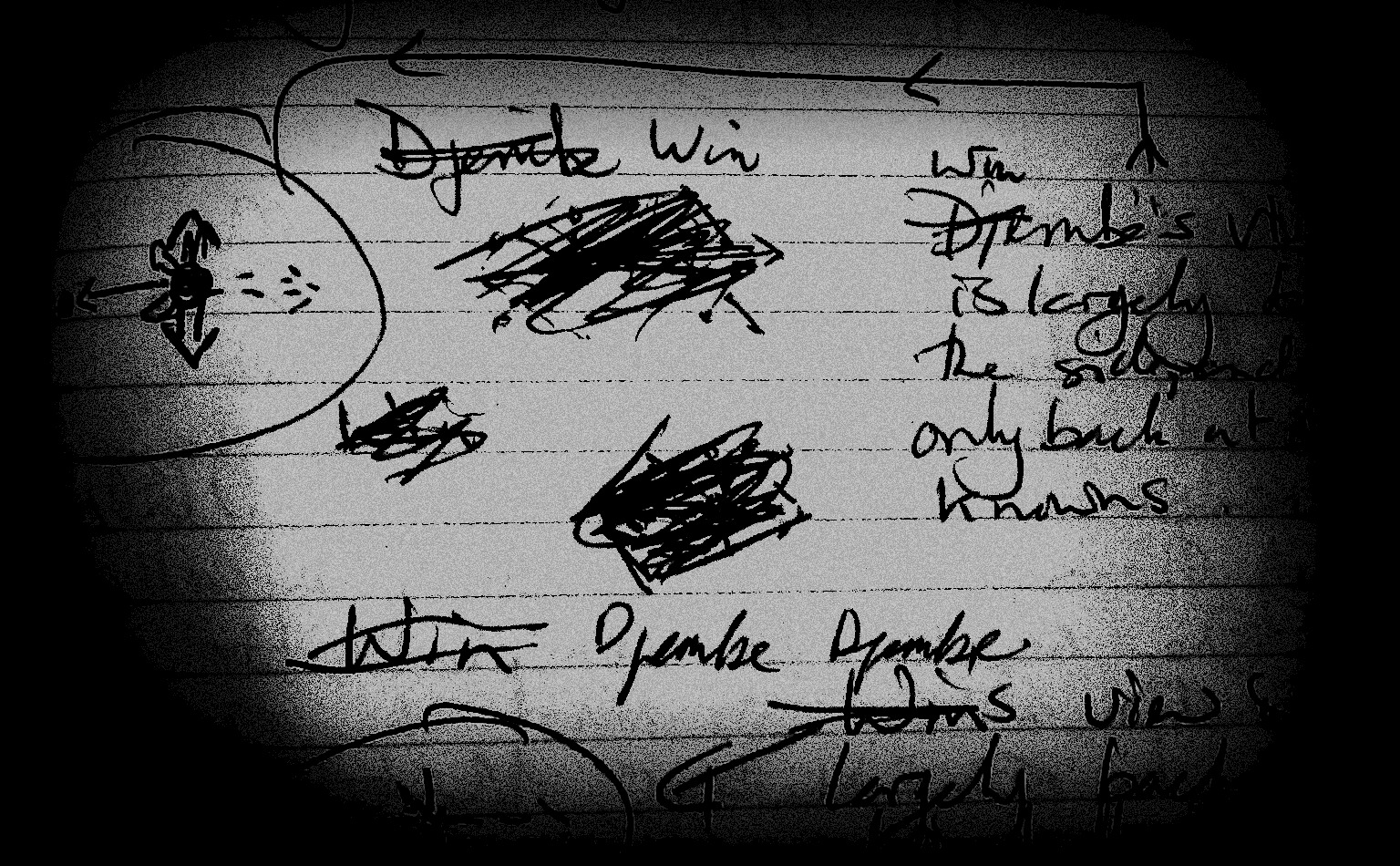
With an initial understanding of his background, I then tried to represent this as a picture. The photo below shows some of this, with the necessary explanation below it:

Planetfall notes on Win

Initial attempt to capture Win's character

Let’s take this picture from top left, go across the page, then drop down briefly to the bottom.

On the top left is a little graphic. In the middle is a dark dot, which represents Win, and out of it come a number of arrows. The strong arrows pointing up & down represent Win’s character trait as described: “Win was a person of the moment, his sense drawn around his immediate presence”. He looks left and right, to his immediate surroundings. A faint dotted line arrow can be seen pointing to the right, representing his limited traits of being a far-sighted person or thinking strategically. You can also just about make out an arrow going backward, which represents Win’s use of scientific data – already established facts, or “knowns” as I phrased it in my notes on the right hand side of the picture.

What you can also see in the picture is that I got confused between Djembe and Win’s characters when I was trying to represent them graphically. The crossings-out at the top and very bottom of the picture show the names being swapped around so that the drawings better tied up with the character biographies I’d written immediately above. What can I say? Sometimes we don’t concentrate on our work as well as we should.

Setting up these early character notes and biographies helped me in understanding how Win would respond to a situation. For example, because he is tied into the moment and the surrounding environment, he is very aware of people’s emotions; it allows him to be a more empathic character. And because of this tendency to empathy and emotional awareness, Win was the first character in the book for whom I developed any conception of family. He is married and has a son (you find this out in the book, and it’s not a spoiler). And because of that, he was my first attempt at creating a character with a tangible emotional centre. My approach was, “If I can get the emotional content of this character right, then I can use the experience to develop the emotional life of the other characters”. I think because of that I formed an emotional attachment to Win, and in planetfall book 1 he’s my joint favourite character (along with Verigua, the Colony’s Artificial Intelligence).

In trying to work out the rest of Win’s character I didn’t have far to look. Having already blogged about the cultural references in planetfall, it will come as no surprise – given my teen years in the 80s – to find that Win is based on the character Data from the 1985 film, The Goonies, but grown up and now aged 42. (For those who need a prompt, Data was played by Ke Huy Quan, and carried about his body a number of ‘wacky’ scientific inventions.)

In planetfall Win’s role is as environmental analyst and general inventor-of-cool-tech-and-weird-virtual-reality-simulations. He gives a lightness to scenes and acts as a foil to Djembe, who is very much a straight laced person. The two play off each other, and while they are very different characters, they are shown to be good friends, both admiring the other’s skills. Because of Win’s character trait of looking to facts and knowns, he is also the major character for filling out the history of planetfall, and for bringing in plot devices by interacting with his environment (translation: he runs around and pokes stuff).

In proof reading, it is Win who is mentioned most often as people’s favourite character, which is very pleasing. Scroll back several paragraphs to where I said, “he was my first attempt at creating a character with a tangible emotional centre”, and you’ll understand why this is pleasing.

So there we have it. Here is another character biography. Was it what you wanted? Would you have preferred to understand how the character developed as I wrote the story? Or about other interactions? If you have any feedback, please use the options on the page to let me know.

Updating the storyboard

The previous blog post was all about editing. How I have several editing passes, which includes typing up from written notes, reading on screen, printing out and going through with a red pen, and the final vocal edit – reading the work out loud.

I think I also wrote about going back to some more character based blogs – about specific characters from planetfall book 1. I will go into those in the next week or so. However, while it’s on my mind (actually, on the desk in front of me) I want to go back to storyboards.

For anyone new to the blog, I draw out a storyboard which describes the overall story structure: key points in the plot. I have no idea what happens in between. As I write I feel my way between those plot points, and that’s where the fun is.

I also write in long hand quite regularly, in Moleskine notebooks. Every time I start a new notebook, I copy the storyboard into it, so that I always have it inside the current notebook to refer to. Sometimes when I’m copying I realise that small details have changed within the storyboard. Sometimes these changes are large, sometimes they are incidental.

Tonight I was copying the storyboard into my current Moleskine and realised that, as I’d been writing from my memory of the storyboard and writing what seemed natural to the story, I’d drifted slightly from the storyboard I’d established some months ago. Here is a pic showing the difference between the original (left) and new (right) storyboard for a particular key plot point:

Storyboard image

Original and new storyboard frame

Now let’s tackle one issue first: I can’t draw, and you shouldn’t expect to understand exactly what you’re looking at! So let’s describe this slightly. In both pictures you see a figure falling through the sky (the shared stick man figure). You can even see some sort of animated speed lines (the two lines going up, with cross hatching across them). This much is the same. So what’s changed?

This scene is key to the books. It shows the “planetfall” which the main character in book 2 takes, and from which planetfall takes its name. (And so for me there is huge pressure to get this scene right.) Originally, on the left, the protagonist was to fall over a verdant planet, swathed in grasslands and prairies, with a river glittering below, a blue snake across the landscape. You can see hints of this in the curved shape in the left hand panel’s upper right area. Small squares along the river’s side are suggestions of buildings, conurbations.

In the right hand panel this is gone. As I wrote, as the protagonist approached this planet, as it made planetfall, the river, the grasslands, the buildings all disappeared. Now there is a crashed ship (the black blob, with the broken lines behind it a gouge in the planet’s surface) to which the protagonist is making planetfall.

This changes things.

The subsequent panel in the storyboard shows some issues around the buildings identified in the left hand panel. Now this has to go. The action has to transfer to this crashed ship.

But can the action remain the same? What was supposed to be in those buildings? Whose buildings were they? Alien or human? And the ship, whose is it? Again, alien or human? Why is there no river now? If there are no buildings, does that mean there is no oversight? If there is no oversight, does that change the scene’s dynamics?

There are consequences to the decisions made in writing. Not all of these decisions are deliberate – the writing often decides where it’s going.

Now I have to follow this path and find out where it goes. As I copy up the rest of the storyboard, I have to think about how it changes. Does it change? Should it change? Does a small change in this panel have any effect beyond the subsequent panel? Or is it a wrinkle that will be smoothed by the overall story structure?

More, perhaps, soon…

(And next time, I promise to get back to some character-based blogging.)


Editing planetfall

The last blog post was a little light relief, a short description of the pens and notebooks I use when I write. (But hey, you got some photos with it.)

This blog post follows up on that, and will lead back to the technical issues of writing creatively. I’ll get back to writing about particular characters in planetfall after this blog post.

I normally start writing long hand. Not always, but most of the time. I do this for several reasons. First, writing can be quite lonely, and writing long hand is best done in a cafe where I can be surrounded by people (ha! and look mysterious and author-ly). Second, when I’m trying to find those first few words, the mechanical nature of moving my hand back and forth across the page feels more interactive than having my fingers hover over a keyboard, watching that blinking sentinel of a black cursor on a white laptop page glare at me. Third, I like to draw.

Now let’s explain this drawing thing. I can’t draw like an artist. There are no secret sketch books filled with pen-and-ink compositions waiting to be discovered. No, in that sense, photography is my creative, visual outlet (see my photography on Flickr). Ever since I was a teenager writing in English Language classes, I have doodled first before starting to write. I’ve written previously about storyboarding planetfall, which combines my habit of doodling with my approach to starting writing.

When I start to write a sentence in a fresh writing session, I often sit and doodle. But these days, in my Moleskines, I doodle without touching the page. I wave the pen nib over the paper and sketch invisible patterns. I see blank lines form traces over the yellow-ish page of the Moleskine, and as quick as they’re formed, they fade. This, combined with the hubbub of background chatter, forms a sort of audio-visual white noise, quietening competing thoughts and dimming distracting inner eye pictures. At some point while waving this pen-as-magic wand, the nib will be attracted to the page, the doodling loops will form the recognisable sigils of letters, I will see the scene in my head, and it will download to my hand and onto the page.

It is because of this process that I prefer to start writing stories and each fresh writing session by hand. I can get to a similar point on a laptop, but it takes a while. It’s generally only after having typed for some minutes that I can see through the laptop screen – well, let’s get this right, that I stop seeing the laptop screen and letters appearing one by one – to the movie playing out in my head, and can access that download sensation.

Which brings me onto editing.

Once I’ve written in long hand, I return to my flat and type up the writing. This allows me a first pass at editing. While reading the long hand and stumbling with my fingers over the keyboard, I notice missing words, clunky sentences, half-completed thoughts, uncompleted cross-references, areas where the scene is sketched but not coloured in. It is this process which acts as a first edit and a first chance at re-writing.

The second pass at editing comes in a couple of different forms, and neither is my preferred second option. The first way is to have a day or so’s break and re-read recent text on the laptop. This I generally do if I’ve written a new long hand scene knowing I’ve jumped a little bit, and need some filler sections. In those circumstances I will need to re-read the last couple of pages to get back into the scene and what’s come already, so I can properly fill in. Sometimes this fill in can be a line, a paragraph, or several pages. The second way, which I do for everything I write, is to print it and read it like a book, with a red ink Uniball gel pen to hand. I make editing notes as I go along. Quite often the editing notes consist of lines through entire sentences or paragraphs: deleting previous writing is a shame, but it is absolutely fundamental to producing the final text. Often I will change words or phrases, pick up my punctuation (I over-use commas) or write new sections. I deliberately chose red pen as it links back to those early days in school, and allows me to occupy another version of me, a separate, slightly more objective version, one that is modelled on teachers and is expected to criticise.

The third and final pass at editing (before the writing goes to other people to read) is the most critical and also the most painful.

I read the material aloud.

Every single word, every single sentence and paragraph and page.

This is a very powerful tool for self editing. I find it painful for two reasons. First, I don’t like my voice. Second, when I read my work, I can get a pretty good sense of how it would sound to someone else (with my voice included). The presumption of embarrassment of someone hearing nonsense is very strong. Yet this is a strong feedback loop. Once you hear your work out loud, you get a very different feel for it. You can hear the sounds, the rhythm, the way different words rise and fall and complement each other. You can finally hear the tone of your work, which can be fundamentally different to how it sounds in your head.

When we edit by reading, we use a limited number of senses. There is the look of the words on the page, and there are the sounds heard by our inner ears (by which I mean, the mental constructions of our internal monologues) and the spatial feel of the words and story in our head: the space it creates and the form that takes.

When we add real sound to this, coupled with the tangible, mechanical feel of our jaws and tongues moving, we add extra dimensions. The story comes alive (or fails to…) in different ways.

A poet would use the process to match sounds to each other within the metre of their verse. I do some of this, sometimes, if it feels important, although I am no poet and do not always have a sense of lyrical sounds in the text.

The simplest thing I get from reading aloud is how difficult it is to read the words. If my tongue really stumbles over certain word combinations, then it will be harder for someone else to read with their internal monologue. If I can smooth the sentence aloud, I know it will read more smoothly to someone else when they read to themselves. (I have had this direct feedback, unprompted, from a friend who proofread part of planetfall book 1: “It reads like someone’s reading it to you,” she said.)

The process is also important for creating a visual environment. Stories have an oral/aural history. The sagas of old were told around camp fires and in huts and caves in the dark. They had to create an inner, visual world for the listeners, both as distraction from the nightmares that stalked the night outside the protected circle, and also so that as many senses were utilised to help the listener remember the tale. I have a tendency to be a very visual writer, to rely on visual creations of scenes to transmit the story to the reader. If the work isn’t read out loud, if I don’t check how it hooks into those feedbacks between our sense of sound and sense of vision, then it will fail to make the final leap: to evolve that internal silent movie on the cinema screen of your mind, into a talkie; a moving picture with original soundtrack.

Editing is a very important process in writing. The writing starts – for me – with a connection between movement and inner vision. When I type I exploit the same mechanism. When I edit I edit visually. But when I do the toughest edit, I combine as many senses as possible – I add sound to the movement and images. This whole process always leads to significant changes to the text, and most authors at some point have spoken on this. To finish, here are two quotations from people deeply involved in (and far better than me at) the writing process:

Harry Shaw: “There is no such thing as good writing. There is only good rewriting.”

Michael Crichton: “Books are not written – they’re rewritten.”

Writing planetfall

Last blog post I talked about finishing planetfall book 1, and writing a synopsis prior to finding a literary agent. I covered my immediate feelings on finising the final edits – that the book will probably end up like thousands of others, lost in a slush pile or flat out rejected, and how that awakened a determination to fight for it.

In this blog I want to step back from the technical process of writing – character development, plot devices, and so on – and give a little insight into some of the materials I use for writing. Other writers may gain more from this than casual readers.

I normally start writing in long hand. That’s not to say I can’t write straight to laptop – I’ll come onto that in a later blogpost. After some experimentation, I’ve found the following work for me:

  • Uniball black gel pen
  • Moleskine notebook
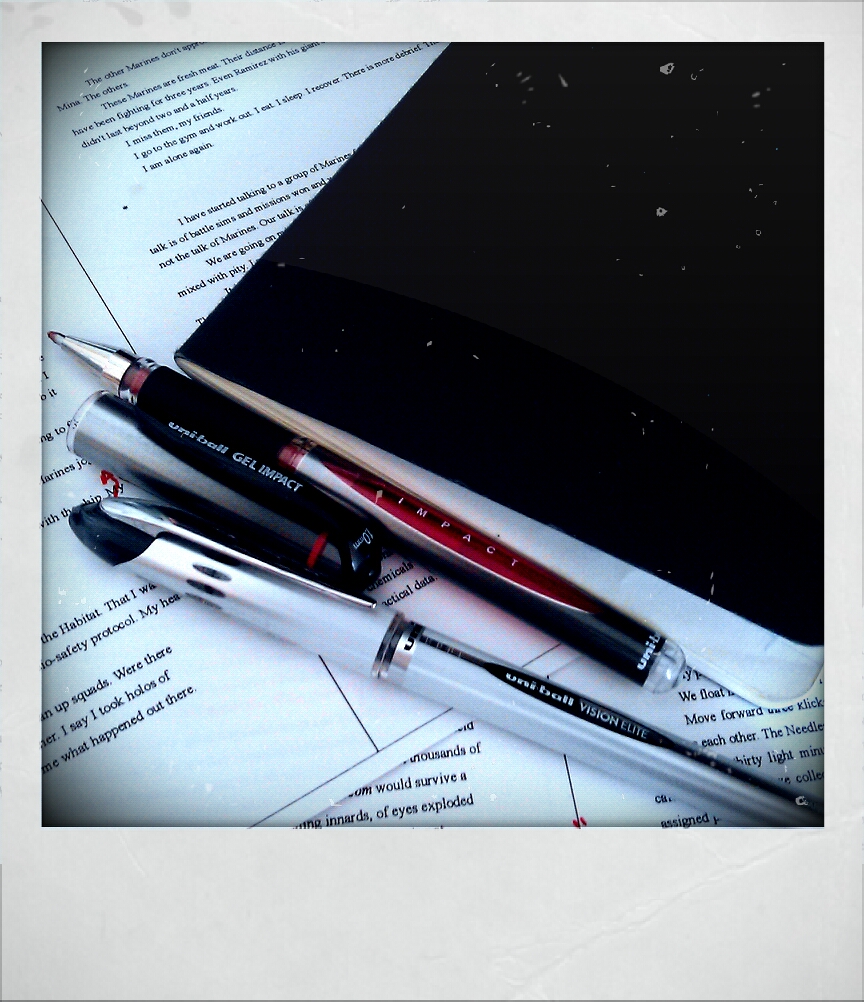
Moleskine notebook and Uniball gel pens

Moleskine and Uniball pens

The Uniball gel pen took some finding. I used to write with biro, and of course if I’m caught without my writing materials and feel the need to scribble, I’ll still use one. When I discovered I preferred starting stories in long hand, I realised immediately that I’d need a comfortable pen to write with.

I have very messy handwriting, and I’ve always found biros too skinny and slippy for comfortable writing. The thin stick of the pen casing digs into the flesh between my thumb and forefinger. The small circumference makes it hard for me to keep a reliable grip. And the easy rolling of the biro’s ball makes slips across the page far too easy. I knew if I was going to manually write stories that I’d need to change this.

I don’t remember how I found the Uniball pens. I know I bought a couple of different pens from a local stationery shop, and chose them all for the thickness of the barrel. The ink-type and nib had no bearing on the decision. The gel ink of the Uniball stood out immediately. It feels to me (and this may not be real, just perceived) that the Uniball has better traction on paper, that there is some resistance. The ink also comes out in thicker lines, which helps to hide the drunk-spider scrawl that is my normal handwriting. The thicker barrel makes the pen easier to hold and more comfortable for a longer period of time. In short, it is a more satisfying writing experience.

Now, the Moleskines. You’ll all be rolling your eyes – so cliched, right? Well, yes, but then cliches come from somewhere, don’t they?

I bought a Moleskine due to a story I read about  a writer who could only write with Moleskines (read it here). I was fascinated. What were these notebooks? It was around this time that I discovered they’d gone out of production. A short while later there was a newspaper article – Moleskines were back in production. This was long before I was writing seriously, so I squirrelled the information away: at some point in my life, I would try one out.

When I started writing more seriously, and found that long hand was my preferred initial method of writing, I resolved to try them. To that point I’d been writing on A4 pads, top bound, flip up. I found them unsatisfactory. Now, I know some writers swear by them. They write with a pencil on A4 block. They write only on on side, using the block’s longer and broader expanse to give their hand room to roam & write and make notes. But I don’t write with pencils – for a start you have to keep sharpening them, which means carrying a pencil sharpener around. I would lose it quickly. And pencil fades and slips across the paper. No, not for me.

I tried, too, Uniball on A4 paper. While I liked the feel of the Uniball, I found the ink is too heavy and thick, and the paper too thin, so that you can see the writing on the other side of the page. I don’t write on one side of paper, it’s a waste of resources. And anyway, I was going to be out and about writing. I’d already decided that. There are too many distractions at home – TV, Wii, internet (internet!) – so I remove myself to cafes to write. Somewhere where there is nothing left but the page and the pen and what’s in my head. Carrying an A4 pad around would be too bulky and awkward.

It was on a trip up the Lea Valley (north east from Greater London) when I was volunteering with Friends of the Earth that I spied a pack of 3 Moleskine notebooks in Liverpool Street Station’s W H Smith. I bought them, put them away, went and did my volunteering (for the Climate Change Act, as it became), came back to London after a pint and my first ever pickled egg, and put them away. And promptly forgot about them. It was over six months later, in January 2008, when I decided to go on a writing break to the Isle of Skye that I dug them out.

And was hooked.

Their covers are made of a rough, black card-like paper, so they look a little mysterious, like they could contain anything: diaries, stories, poems, sketches of sweethearts and brawling drunks. They have rounded corners which don’t get caught in things. The paper is thicker and yellower then A4 pads. The Uniball gel ink clings to the paper and draws the pen across its surface. They are a construction made for writing.

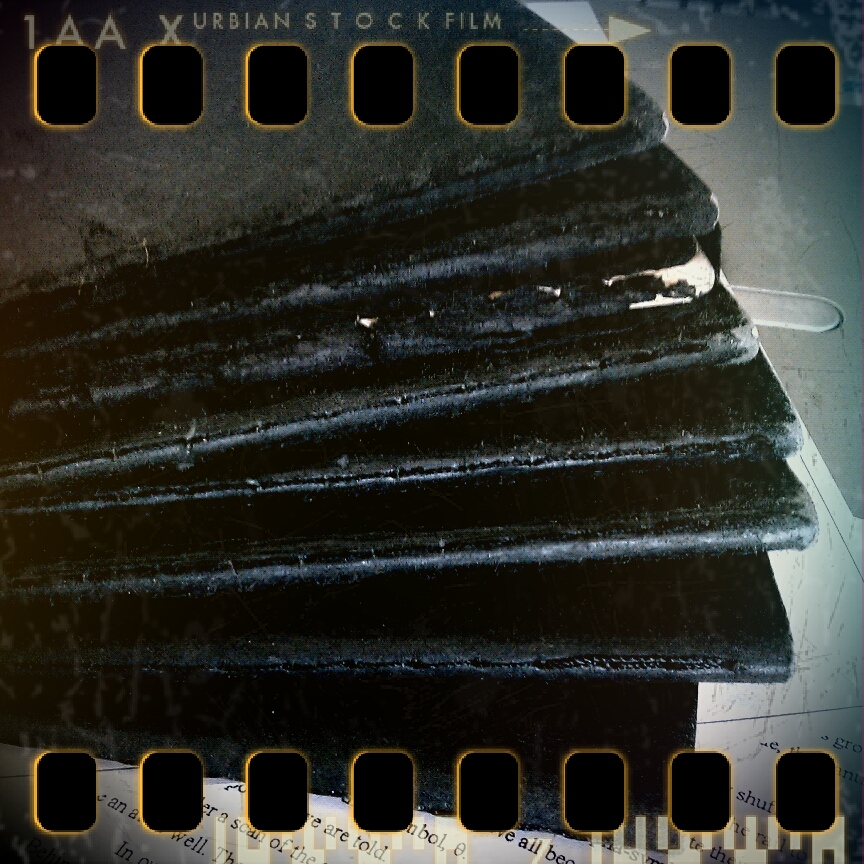
Stacked Moleskine notebooks

My Moleskine notebooks

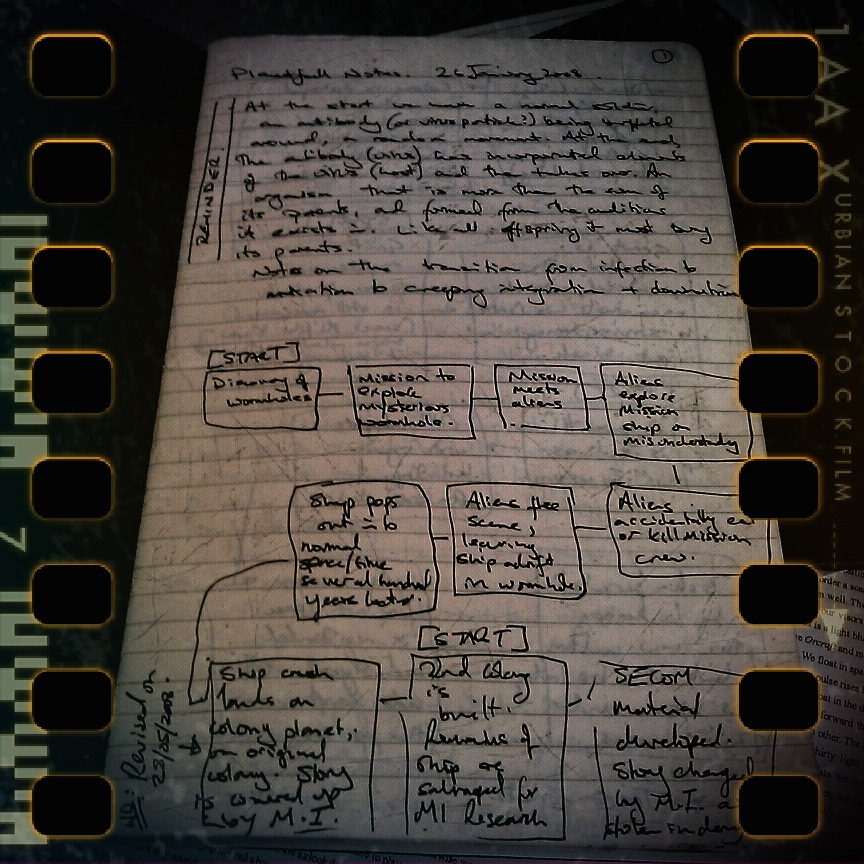
I have since filled 7 notebooks with notes and storyboards and thoughts and plans for planetfall and a couple of other short stories (Ayla’s Journey, First Things First, The Boy). The picture above shows the 7 filled notebooks and the current 8th, and the picture below shows the first page from the first Moleskine I ever used, including my first attempt at story boarding.

Moleskine notebook opened to writing page

The first page of the first Moleskine notebook, plus my first ever story board

I now carry my notebook and pen with me pretty much all the time. There is always time to scribble something down, even if it’s a word, a short sentence, or just looking at what I’ve written, or the story board to fix the narrative in my mind.

When I write in the notebooks I record the date, time and place. Although it is not meant to be a diary, it gives me, of course, a reminder of where I was at particular times. Sometimes leafing through past notebooks makes me wonder why I was free at 14:52 on a Tuesday, rather than at work. In that sense it records some of the context of my life as I was creating this other place, this other world, these other people, these other events.

So there we have it. Uniball gel pen, Moleskine notebook. That’s how it all starts. Next time, a little something, I think, on transferring the writing to the laptop and how I go about editing the work.

Ends and beginnings

In the last blog post I talked specifically about one of planetfall‘s main characters, Kate Leland, and more generally about women in sci-fi. In this blog post I want to cover something a little more personal – my own story through the writing of planetfall book 1. It’s a bit of a ramble, a brain dump of how I felt in the minutes after I’d finished final edits (indeed I wrote it straight after finishing). But in that, it’s a representation, in all its unfocused mess, of what was circling in my mind. So here we go:

Today (12/06/2011) I finished final edits on planetfall book 1. As far as I’m concerned I now have a draft that I am happy to send to a literary agent, and for a literary agent to send to publishers. That doesn’t necessarily mean it’s a perfect version. It just means that I’m happy with the book, that I think it works, and that I think there’s enough to satisfy a reader. An agent and a publisher might (would!) of course have a different view.

From my research, it seems that getting published is not wholly about how good your book is. There will be a huge degree of luck in this, and not a little networking required. (For the cynical, or the realists, depending on your world view, you can read “networking” as “selfish exploitation of other people’s contacts”.)

I first finished planetfall book 1 in December 2010. I remember writing the (then) final words, “…we’re coming in hot. Out.” These are not the final words of this final draft. As a nod to the sequel, as a nod to the fact that the story ends just as another great story is so obviously beginning, and as a nod to the fourth wall breaking history of literature and performance, it now ends with the line, “This story isn’t over.” It is perhaps something of a cliché; undoubtedly there are hundreds, thousands of first-part stories out there which end with similar or identical words. Yet they seem to fit: to fit the story, to fit the character, to fit the tone of the end, and to fit the start of the book, its opening paragraph, which – perhaps fittingly – is where I made the very last edits, the very final changes. The opening paragraph has been re-written scores of times now. It starts now with a paragraph that contains the following (with some intervening words edited out), “ the system seemed to be looking for … a story”.

There is some symmetry now in the story. It starts with eyes opening, of vision across great distances, looking for a story to tell. And it ends after a story, at the junction between one story and another, as the main character’s vision is compromised, a door closing, cutting off their virtual sight lines, of being locked into the dark, and having to look inward, of having to use the insight they gained along the way to understand what is happening, what might happen next. “This story isn’t over,” is me talking to a reading audience. And at the same time it is the character – Kate, let’s name her, the main character – continuing her blossoming from a strong character who is highly competent in specific situations, to a character learning to be strong across broad, unstructured, unfocused, society-wide situations. A generalist. A General.

Kate’s story is not over. She will crop up in a later book. At the moment I don’t know if she will be in the sequel; sharing her own initial lack of vision, I can’t yet “see” her there. Her presence is there, she is still part of the story, she will be back, and she will be back to drive the story to its conclusion. But when? Where? Therein lies part of the joy of writing a story, a joy shared by the reader – I don’t know until she crops up and becomes apparent. I look forward to finding out who she is, how she’s matured and changed and grown in the intervening story time.

Back to the story as a book in reality. It has grown and changed and matured over time. From its inception as a 1-page short story about a Mexican soldier, to its recasting as a story about a space Marine, to my need to pull out a sub-plot and make it into the first book; through the various drafts, failed story lines, red herrings, dead ends, characters who changed gender, characters meant as throw aways who became more important as the story grew and took on its own life, from all and through all of that, it has finally become a product finished and polished and independently read enough to stand on its feet, on its own merits, and be sent into the big, bad world of literary agents.

I expect rejection letters, of course. I expect no letters or responses. I expect to feel the slow and creeping disappointment of a creation left to wither due to lack of the oxygen of attention.

Or perhaps I owe it to this funny little sci-fi story to keep it alive. To animate its existence with networking and exploitation and letters and phone calls and requests to friends and acquaintances and emails to business cards picked up in restaurants, given by kind friends of friends. Perhaps I should be inspired by the story’s will to power, the fact that it created itself out of nothing. This book that forced itself out of a writing exercise, that budded off from a parent story, plopped onto a page and wriggled and writhed and entrained my hands and mind and time and money, and birthed itself, which took over like a memetic virus my brain, so that I became enslaved to it for three years, so that I spent evenings and weekends and minutes between work meetings and train journeys and rainy weekends in remote cottages in the Scottish isles, and sunny tables in hostels in Africa, train carriages across Europe, coffee shops around London and Coventry and who-knows-where-else (in fact I do, they’re all recorded, timed & dated); this book that dragged itself from the aether into the world. That has implanted itself in other people’s existence and minds and experiences. This book mentioned on Saturday night television to an audience of millions (no, it’s not sodding Avatar 2). Perhaps the real journeys the book has been on mean I should continue to subjugate myself before it. To serve it until it dies – the death of a public readership, who will absorb it and own it and add their own lives and thoughts and opinions and colours and textures to it.

Perhaps the end of the book is a beginning for it.

I have finished this book five days before my last day in the office in my current job. I decided to leave this job three and a half years ago – almost the same month I started writing this book. I have finished it when I am finally leaving.

Across the three-plus years I have learned – in parts, a little bit – how to write. How to sustain a story over hundreds of pages. How to develop characters and ensure that, if I want, I can make them have some emotional impact on the reader. I have learned about description and context and flow and movement and how to generate tension. I have learned to write dialogue (although I am still not that good at it) and I have learned, approximately, how to structure a chapter. How to story board. When to write prescriptively and when to let go. When a story and character should write themselves and when to exert some control. I have learned I can create people I don’t like, who nevertheless continue to live and breathe inside me. I have learned not to be scared to let a character or situation do things that seem outlandish, to follow the logic of a story. I have learned that humiliation – giving your writing to other people to criticise and tear to shreds – never becomes blunted, but is as important to the writing process as putting letters on a page. I have learned that people can unanimously like parts of my writing that I feel nothing for. I have learned time can be made and found in a busy and hectic social life, and that Edison was right: producing something from nothing is 1% inspiration and 99% perspiration (so he was talking about genius, but a little poetic licence is OK). Writing is work and you just have to get on with it.

This book started as an exercise. It was going to be a practice novel. It was going to be something written quickly and slapdash, something to develop a skill as a writer of books, so that I could write the book I really wanted to write. It was supposed to be throwaway. And over the years I grew fond of it, grew to love it, grew to realise that perhaps this piece of throwaway writing actually had a little more going for it than an exercise in dialogue and getting away with bringing back flying saucers in the sky.

Today I finished edits on planetfall book 1. Today I ended 3.5 years of effort on a single product, a single creation. Today I completed, in my mind, the equivalent of a degree in creative writing.

Tomorrow… Tomorrow we will see what legs it has.

Kate Leland & women in sci-fi

In the last blog post I posted a teaser pic from my storyboards! The written blogpost before that was about getting feedback on planetfall book 1, and dealing with other people’s views of characters. In this blogpost I want to pick up from the feedback angle, and go into a little bit of detail about Kate Leland, the principal character in book 1:

I recently received a critique of the current draft of planetfall book 1. Amongst the various comments noting what worked and what needed more work, was a comment about the characters in the book, “I liked that women held many of the positions of power.”

Sci-fi has traditionally been a male preserve – or if not a male preserve, at least perceived by the vast majority of people as a male preserve. There have been few female role models or characters in sci-fi.

Two of the highest profile female characters in popular sci-fi are often singled out for the most criticism. Princess Leia Organa and Queen Amidala / Senator Padme Amidala, both from the Star Wars films, start off as strong characters, helping to drive the plot. In both trilogies (episodes IV-VI for Leia, and I-III for Padme) the lead female character becomes weak, insubstantial and subject to the whims of men. For Leia, she starts as an Ambassador to the Imperial Senate, is then revealed and seen in Empire Strikes Back to be a leader in the rebellion, and ultimately is reduced to a bikini model in Return of the Jedi, ineffectual, and desperate for the love of Han Solo. By the last film her leadership qualities have all but disappeared from the narrative. She is rescued by men after being subjugated, is desperate for Luke’s emotional bond, is repulsed by her connection to her father, is shot, injured and cared for by an ascendant Solo, who by now has turned from smuggler and rogue to dependable General, father figure and provider.

And so for Padme. In her first film she is a queen, a strong figure defending her people, and starts the first rebellion against the Trade Federation, personally leading her people into battle. In …Clones she is a senator to the Republican Senate, resists Anakin’s advances, and at the end is a warrior alongside the Jedi. Her tumble from the gunship at the end of the film foreshadows her loss of power in Revenge of the Sith. By the time of this film she is pregnant and emotional and clings to Anakin. To be fair, in a pregnant state, many women will want to be nesting and have the father around to provide stability. But her role as creator of the rebellion is missing from the film. The scenes were filmed, the political aspects of the film – which would round it out and make it a more mature piece – are left on the cutting room floor. We are left with Padme as a weak person, wobbling around with a swollen abdomen, unable to save the man she loves from becoming a murderer, unable to stop him from committing infanticide even as she carries his own children, and unable to stop him from turning to the Dark Side. Until eventually her desire to save the man she so long resisted results in her death at his hands.

One reasonable reading of this, is that no matter how strong women start off, they will end up as weak and ineffectual, in thrall to more charismatic men, while those same men go off and continue to decide their own fate and those of others (for good or ill).

In planetfall I deliberately wanted to avoid this.

The main character of book 1 is a woman, Kate Leland. Her character is intended to be the best of women in sci-fi. Strong, forthright, intelligent, and compassionate as well, but without that compassionate side being her undoing. Similar, in restrospect, to Captain Janeway in Star Trek Voyager.

The story centres around Kate’s desire to discover alien life forms, in a galaxy apparently barren of them. Early in the story (no spoilers, don’t worry) she is sent to investigate an apparent first contact situation. And she is sent against a powerful man. A man of no little dark mystery, who puts Kate in the way of conflict and inner turmoil.

I never considered that the main character in this book would be anything other than a woman. In fact I had no choice in the matter.

The first draft of the first 30 pages centred on Daoud, to set the scene on the Colony world of Fall. The character Sophie Argus followed within about 2 pages. Sophie was designed to be a strong character, someone who has more power than is at first apparent. She does in fact have more power than is apparent in book 1, but that, I hope, will come out in future books. For a short while Sophie was going to be the lead female character, and the more I dug into her character, the more I realised planetfall was all about her – and that this wasn’t the right book to make her the dominant, lead character. So she has a supporting role, and that left a gap in the story.

For a couple of months I was stuck at around 30 pages into book 1. I knew the overall storyboard, I knew who Daoud was and what he was up to, and I knew that he needed a foil, an equal, someone with whom he could dance through the narrative. I never considered that his foil would be a man: it had to be a woman. But if not Sophie, then who?

After a couple of months of struggling, I had a realisation about the way I was writing. My imagination was on the planet, in the colony, waiting for someone to arrive. Every time I looked out of the planet, up into its skies, I could see a ship approaching, but not who was in it. I could see into the future of the story and see someone arriving, but the details were missing, lost in darkness.

Eventually I realised I could just change my perspective. Rather than looking from Fall up into the skies, from Daoud’s perspective essentially, why not look the other way – from the perspective of the person approaching Fall. This realisation, this shift in perspective, took about 2 seconds to have an effect. With that re-alignment of the story’s camera, I was suddenly on a space station, with a team of 3 people. And sitting, in reality, in a coffee shop in Crouch End, I zoned out, my eyes blurred, I was locked into my mind’s eye, and – BANG! – out of nowhere, this woman walked into my head, fully formed, fully imaged, her character almost complete. Her name followed in the next minute or so. I knew it would start with a hard sound, something substantial, not a soft thing like ‘m’ or ‘w’ or a baby sound like ‘b’ or something weak like ‘f’. It would be a hard sound, to give the name an immediate punch. A hard ‘k’ sound popped up naturally. In the first month I hadn’t decided what the name was, and in my notebooks she wobbles between Karen and Kate. I eventually let go of the name Karen because it’s too lyrical, it rises and falls after the ‘k’ sound. Not so with Kate. It’s short, punchy, one syllable long, and ends with a similarly hard sound, ‘t’. Kate’s surname, ‘Leland’, just popped into my head once I had the ‘k’ sound to start the name. In the minutes afterward I tried to reason where it might have come from, and while in my subconscious there may be some proper explanation, as far as I can tell consciously, it just popped out. My back-casting would say it’s based on Leland Palmer from Twin Peaks. Or that it’s a nod to the defunct British Leyland brand, a sign, once, of solid engineering. But it’s neither of those things. ‘Kate Leland’ was just the name that popped out, and it doesn’t really bear closer scrutiny than the sounds of the first name.

Kate is the principal source of tension and conflict in the story. Her character has a journey to make, and a choice, too – she is presented with a dilemma by Daoud. Now Kate could quite easily sidestep the tension if she could think more strategically. Indeed, any major character in any book could avoid most of the tension and drama if they could just make certain connections quicker – but where would the fun be in that? And besides, it would make them gods, able to understand everything going on and able to influence it with omnipotence. I found, in the first few weeks of writing about Kate, a tension within myself. I wanted her to be strong and intelligent, and I wanted a decent female role model. And that meant not giving her any weaknesses. But of course we are human, and we all have weakness and lesser abilities amongst our strengths and capabilities. The challenge I found after that was how to make her all too human and keep her strong, while handicapping her so that the principal, central conflict of the story was maintained.

I found the answer in two places, which both led to the same answer: the first was a person I once worked with, an intelligent person who couldn’t see the wood for the trees, who was mired in their own prejudices, which would blind them to more strategic thinking. And second in my initial ability to know that someone was arriving on Fall as Daoud’s foil and the role they would play, matched to my inability to know who that was specifically. Kate’s weakness would be the same – far sighted enough to see the outcomes and consequences of events, and to make intelligent predictions about the future, while missing the key fact that would help her. This is reflected in parts of the book, for example, the sequence of Kate going into the tunnel:

“She gazed, searched, squinted into the darkness, the deep black with its mysteries so close, so hidden.”

There are examples in the first half of the book about Kate being unable to see, of her vision being obscured. The light that she really needs to illuminate her is missing – it is no coincidence that she is surrounded by holograms, which for the most part are insubstantial light, unreal and outside her body. They are are a false light, externally supplied information, where what she really needs is insight, internal illumination.

In the second half of the book, Kate’s character has a turning point, although its consequences are not fully realised in book 1. When she commits herself to a journey in the dark, the tunnel-as-metaphor, she makes a mental breakthrough, and her vision starts to clear. It doesn’t clear quickly enough to avoid the events of the book’s end, of course! The point where her character makes that leap in understanding is at the end of the tunnel, in the chapter, “Something wicked this way comes”, when this happens:

“Kate turned around, her eyes wide, still accustomed to the dark, to the claustrophobic airlock, the lightless pasage beyond, adrenalin coursing through her, and faced a bright, blinding light.”

Here she is still trapped by her inability to see what’s coming. She has approached but is blinded by the light, incapable of seeing what’s in front of her, what’s staring her in the face. Her journey through the darkness of the tunnel ends with a bright light. And here she has a final choice. Go back into the darkness, be “claustrophobic”, stay in the darkness the rest of her life, or go into the light, be ‘enlightened’, and learn a greater truth. Our major characters have to go through some test of faith, or even several tests, to prove themselves worthy of our admiration. Kate eventually commits to a course of action:

“Kate blinked, closed her eyes to slits and took two confident steps forward. She didn’t want to show weakness or panic again.”

Not one step forward but two. Far enough that she can’t take a simple step out of it.

By the end of book 1 she grows into a more mature character, is caught between different courses of action, each with horrendous consequences, and tries to navigate a course through them. And while there is a completeness in her actions at the end of the book, Kate’s story is unfinished. The outcome of her decisions are explored in more detail in book 2. And for that … you’ll just have to wait.

Coping with feedback

In the last blog I wrote about “MacGuffins”, which are a device used in stories and films to drive the plot. The Ark of the Covenant in Raiders of the Lost Ark is a MacGuffin: the characters chase after it and only really get their hands on it near the end of the film. The blog also covered issues of failure. planetfall had a series of MacGuffins, some of which initially failed, causing me to develop the storyline further – only for one of the original MacGuffins to go underground in the story (literally) and surface as a sub-plot.

I want to carry on with the failure theme in this blog. Failure is a very important factor in success. The fact that planetfall was started, written and (almost) finished is a testimony not just to my perseverance, but to the many, many failures I encountered and made and caused along the way. The point of course is: use failure, learn from it, and keep going.

The failures I’ve talked about so far are failures that I’ve spotted and come to accept myself. Failed storylines, failed characters, failed MacGuffins, failed structures and failed sub-plots. Now I’m going through a separate set of failures: those spotted and communicated to me by those friends who are proof-reading book 1.

For politeness’ sake we call this constructive criticism and feedback. But in reality, it’s another failure.

So far feedback on planetfall book 1 is good and positive – people like it, they enjoy the story and reading it, they like the characters, they want to read more. All very pleasing. And it’s very important to know, as a writer, what I’m doing well and right – then I can do more of it, gain some confidence that those things I did, those things I wrote, those risks I took have paid off, were worthwhile.

Yet it is the bits that don’t work, the parts where people feedback the “Ooh, um, see this bit?” where we learn more. And ultimately it is addressing those failures that will strengthen the story.

The most consistent failure to date has been that of character development. There are six principal characters in planetfall book 1: Daoud, Sophie, Verigua, Kate, Win & Djembe (plus four minor characters, Masjid, Peter, Huriko and Kiran).  Daoud is mysterious, his intentions cloaked, and his character is developed enough to create, I hope, this air of mystery. There is little background or insight to his thoughts or feelings precisely because he needs to remain mysterious (though if I ever get there, the final book and the prequel stories will reveal more of his character). Verigua, as previously mentioned, was a fun character to write, and invented itself as I wrote, based on the Cheshire Cat and Haruki Murakami’s black cats, plus a bit of Iain M. Banks’s Minds.

Which leaves me with three characters where feedback consistently asks for more.

The character Sophie Argus is also mysterious. She is Daoud’s right hand, the implementer of his whim. The text contains hints to a long history and background with Daoud, yet this is never explored. Events later in the story (no spoilers) also hint that there is more there for the reader to access. In short, feedback says: tell me more about her. The answer is simple: no. Sophie has a much longer story arc than book 1, although this is not immediately apparent from the text. I have 3 books scoped for her, with another 3 for scoping at some point: if I get my way, I would like to franchise the writing of planetfall books, and have other people write the back story. For planetfall could reasonably be called The Tale of Sophie Argus. It is all about her, from beginning to end. planetfall book 1 is a key moment in her life, although her presence in the book is somewhat shrouded. Readers (when they eventually appear) will have to wait for her story to be revealed – and it will set book 1 in context for them.

Which leaves us with Djembe & Kate. I accept the feedback from everyone – there is not enough about them in the story. Their basic motivations are apparent – Djembe is a follower of rules and protocol, and with his name being borrowed from a drum, provides the beat and rhythm for the story. Readers will eventually find he has a project management role in the story, keeping people to time. His name is no accident. However, criticism so far shows that his rigid personality works, but that it fades or is watered down near the end of the story. I was minded to ignore this feedback, as Djembe also has a longer story arc than book 1, and in fact his personality is not watered down in the slightest. However, as I got more feedback I came to realise that within the confines of book 1 Djembe does indeed more development. There are questions left unanswered about his actions later in the book, where he appears to lose his way. This in part is my fault – I’ve written before about not particularly liking the character, and there was a point where, having given in to the character and allowing it to write itself, I grew tired of him and allowed him to drift into the background. There was a deliberate thought process to this – it’s linked to his re-appearance later in the series – but what I’ve realised is that this needs explaining; or, at least, contextualising, so that the reader accepts a fade out toward the end of book 1. This forms part of my current re-writes on book 1.

And finally we have Kate, ostensibly the main character of book 1. She also has a longer story arc than book 1, and I think I managed to give her a complete and enclosed story line in book 1 (i.e. it appears to make sense and have a beginning, middle and end). However, overwhelmingly everyone asks for more on her thoughts and feelings. She is the principle source of tension in the book. Her hopes and dreams, her values are put to the test, and there is simply not enough about her inner struggle to justify her character, no matter how complete her overall story line.

I find this failure to present completely rounded characters humbling and instructive. I don’t want to excuse myself with a “it’s my first book” line. Managing six principal characters and four minor characters is no mean feat. But it doesn’t excuse not presenting well developed major characters. I am already using the experience to flesh out more the characters in planetfall book 2.But for the moment I am trying to go through a finished novel and weave in extra characterisation which makes sense, is consistent with the rest of the story, supports and develops it for the reader, and meets the need to address the failures of the draft version.

I hope, of course, it will lead to a better, more rounded, more complete first book, that can stand up on its own and escape, as much as possible, a “first book” feeling.

planetfall & the MacGuffin

In the last blog I introduced planetfall book 2, its main protagonist (a space Marine), and the first-person approach it will take, with the Marine having no name: essentially the Unnamed Soldier.

In this blog I want to return to planetfall book 1, and talk about a specific plot element that helps drive the story. It’s a thing that many of the characters are either trying to find, or keep hidden. Sometimes this thing reveals itself, subtly, tangentially, metaphorically, but most of the time it is mysterious. At no point do the characters who are trying to find this thing ever get their hands on it.

This thing is the MacGuffin.

Alfred Hitchcock popularised the MacGuffin. He said that, “In crook stories it is almost always the necklace and in spy stories it is most always the papers”. It is the thing that causes the characters to run around. It is the thing around which events happen. And it is generally inconsequential to the plot of the film, despite being central to it.

In Indiana Jones land, the Holy Grail and the Lost Ark of the Covenant are the MacGuffins. Indy spends most of the film trying to get hold of these things. As do the bad guys! And then it turns into a race to steal it from each other. In Star Wars Episode IV: A New Hope, the stolen Death Star plans are the MacGuffin. In this scenario the good guys have them and are trying to keep hold of them and transport them to a safe place. It is the bad guys who are trying to get them back.

Often considered the most beautiful example of a MacGuffin is Rosebud, the last word of Kane in Citizen Kane, and it is the protagonist’s attempts to work out what it means that drives the plot.

So description aside, how is this applied to planetfall? What’s the MacGuffin?

I was inspired to write this blog post by graphic designer and bloopy sound producer Dave House (listen to his Reverse Engineer stuff), who tweeted me after reading just 10 pages of planetfall to say he’d “started reading it and is hooked after 10 pages. Mystery black blobs and fungal panspermia. Loving it.”

I started thinking back over my original intention for planetfall‘s MacGuffin: the black pods – because “mystery black blobs” is exactly how they started life. Without giving too much plot detail away, in planetfall the existence of the black pods is revealed to the reader very early on (another plot device borrowed from Hitchcock, but for another blog). The characters presented as the searchers in the story, the ones looking for something, are kept in the dark about them. During the course of the book they spiral closer and closer to coming into contact with them. But do they get them? Do they even know the pods are something to get?

As I wrote and developed the concept of the black pods (reverse engineered from the material secom which appears in book 2) I realised I needed something stronger as a MacGuffin; the black pods just weren’t working out in my initial planning and writing. I needed something elusive that would give the characters something to do, and continually keep them moving to other situations. So the black pods fell out of favour, and I developed another MacGuffin, which I will mention briefly below. The pods, though, in being abandoned as the story’s principal MacGuffin, refused to give up so easily, and acquired a life of their own – they were just too interesting to abandon from the story, and so turned into the driving element of planetfall‘s cyberpunk underbelly, a part of the story I had never planned or envisaged until it popped out one day in the ubiquitous coffee shop in Crouch End.

This is one of those wonderful artefacts of failure. I tried to make these black pods – analogous to the black box of technology and physics explanations – into a strong driving force for the main story, and failed. In failing, they rallied in my mind, coupled themselves to a character, Verigua, who had charmed its way into the story, and ended up creating a whole story line of their own. It was unbidden, it was unplanned, it wasn’t storyboarded, and I had a lot of fun and frustration and thrown-out writing trying to figure out how they actually fit into the main plot of planetfall.

I wanted to write about this failure-leading-to-success for any others reading this who are writing or thinking of writing a story of their own. Failure is a necessary part of success. You have to try things, work with them, and throw them out if they’re not working. Because sometimes in the act of “killing your darlings” (as a friend once put it), you find something more interesting and creative than you could have come up with on a blank piece of paper. Failure is an option; in fact it’s essential to success. But it has to be coupled with determination and keeping going. This is something that too few of us realise or are taught, I think. It doesn’t matter if you fail – it’s that you tried in the first place. But if you try and fail, and learn nothing, then you have truly failed.  If you try and fail and learn and evolve and learn (and maybe go back to it with something based on your failure) – ah well, then you’re a success. It doesn’t feel like it at the time, it just feels like you’re set up to fail again.

Back to the real MacGuffin of planetfall. On the first page of the book (so no plot giveaways) a character is killed. It is that character’s death, and the hunt for the killer, that is the real MacGuffin.

planetfall starts off as a sort of murder-mystery. It’s a whodunnit?. And like most MacGuffins, as I said at the start, it keeps the characters running around and having fun, while the other MacGuffin, the one that refused to go away, slowly and inexorably catches up with it.  How that happens – well, you’ll just have to read the book when it’s released!

So what about planetfall book 2? Does that have a MacGuffin?  Is there something the characters are chasing or trying to protect or steal or find or figure out? At the moment, even I don’t know. And it’s going to be fun finding out.